My previous post said that I will be reading 52 books in this year's 52 weeks. I fully intend to achieve that goal. Here is my progress:
As of last post, I had 6 books down and now, by the end of January, I have 10 under my proverbial belt. Huzzah! I am trying to take as much advantage as I can of the fact that, after this week, a major source of "reading material" will be homework and exams to grade. I realize that this is of my own doing, and I could alleviate these obligations by merely assigning less written material but ... hey, who are you, my students?
So I know my reading pace will slow as the semester carries on. I at least feel some comfort in the fact that this is due to an increased pace in writing: I type all of my lecture notes and share them with my students, I type homework solutions, and so on. I'm not a passive teacher. And thus far, I have maintained a good pace, even as classes have started, but I think this is specifically because I know what will eventually happen. I find myself making more and more time for reading than I've tried to before. What's nice is that this hasn't at all felt like a chore; I'm loving this experience.
Here's what I've managed to read since my last update:
7/52: A Clockwork Orange, by Anthony Burgess
So glad I finally read this. I'd seen the Kubrick film version years ago but only remember some of the more sensational parts. It was particularly enlightening to read Burgess's thoughts in the intro and then read the book thereafter, knowing what he intended; did you realize the US version was missing an entire chapter, and the Kubrick film was based on this incomplete version? #TMYK
I'd also like to nab some of the slang here and use it in daily life. "Appy polly loggies" is probably my favorite. "Horrorshow" is good, too. Here's a big list of all of them.
8/52: Fantasia Mathematica, edited by Clifton Fadiman
This is a compilation of short stories, poems, limericks, and excerpts of longer pieces that happen to deal with mathematics in a literary way. Now, this was compiled in the early 1960s. This means that many stories/poems are totally outdated/contrived. This also means that some humor and writing is timeless, though. Part of the beauty of this book is reading through and discovering what kinds of ideas carry through the years and which die by the wayside.
I found this book in the Emmanuel library and started reading it because I've been thinking of designing a course on "mathematical literature" or the like, and this seemed like a good source. I ended up reading right through its material in a matter of four days. By the by, if you have suggestions of reading material for a course like this, send 'em my way!
I liked this book particularly for its selection of stories from Martin Gardner and its inclusion of a story about a Moebius Strip in the Boston subway system.
9/52: How to Lie with Statistics, by Darrell Huff
I borrowed this from a colleague and finished it the next day. It's a quick and enjoyable read, yet highly informative at the same time. The cartoons throughout are quite funny and helpful, too. I will continually recommend this to everyone I know, especially those who view themselves as "not a math person". This book promotes some essential literacy in basic statistics, and can keep you from being swayed by a distorted infographic or a misleading advertisement. Honestly, this should be required reading for every high school student in the world. I'll get on that … If you haven't read it, here's a free .pdf copy. No excuses!
10/52: The Road To Los Angeles, by John Fante
This is actually a reread from year ago. Sometime in college (maybe shortly after), I read this from a library, knowing that Fante was a significant influence on Charles Bukowski (and one of the few writers Buk openly praised, at that). It's truly a character study, and Arturo Bandini is truly a character: he's an ass, unnecessarily pompous and self-righteous (but perhaps not as extremely as Ignatius J. Reilly … perhaps), but I can't wait to see what he does and says next. The prose is pretty "racy" and "vulgar", too, considering it was written in the mid 1930s (and, indeed, never published until after Fante's death in 1983). I also have copies of Ask the Dust and Dreams from Bunker Hill (two more books in the Bandini "series"), so I'll be reading those next. (I know this interrupts an earlier commitment to Gravity's Rainbow, but I've now committed myself to that being the book I read right after finishing these Fante novels.)
Up next:
I'm almost done reading Philosophy of Mathematics by James Robert Brown. It's unapologetically Platonistic, and it's tainting my enjoyment a bit, but there's lots of ideas and examples in here that I'd never considered. I read a quarter of this book before January 1, so I'll think about whether to count this towards my 52 goal.
I found a cheap used copy of Levni Yilmaz's Sunny Side Down recently. This should be another fun and quick read. If you don't know his "Tales of Mere Existence" series on youtube … then you're missing out. This is a good one on procrastination, and this is a silly one on food.
Until next time!
A convenient place for me to unload scoops of metaphorical brain matter. The title refers to a book of poetry by Charles Bukowski.
Showing posts with label literature. Show all posts
Saturday, February 1, 2014
52 books - January update: 10/52
Labels:
2014,
52book,
a clockwork orange,
book,
john fante,
literature,
martin gardner,
math,
reading,
statistics
Tuesday, January 21, 2014
2014: 52 weeks, 52 books
This is my first sentence; it's a meta-statement about how I haven't posted here in a year and a half, but it refuses to make pointless excuses as to why, nor does it propose any reasons why I would choose to write again now.
I've been reading a lot lately. By "a lot" I really mean "more than usual, on average over a given time frame, than in past years of my life". And by all of this I really mean that, over the last few months, I've found myself reading books (a) more often, (b) more voraciously, and (c) more sustainably than I usually do. I've enjoyed this trend quite a bit.
Last August, I started my first post-graduate school job. I'm now a mathematics instructor at a liberal arts college. This does not mean I find myself with more free time than in the past. (Despite what people say about graduate school, I think it's a great time to pursue hobbies and leisure activities; you just have to be more careful and adamant about managing your time.) If anything, quite the opposite. It's hard work fitting in to a new set of colleagues, working with an entirely new student body, managing expectations (both what you expect of your students and what they expect of you), and cultivating a social life, when you have time. But somehow, I've found myself with lots of time for pleasure reading.
Maybe it's just that I've finally decided, "I will make the time for pleasure reading. And I will do it often." I don't go to the movies. I don't go to bars on the weekends. I don't have cable. (I have a TV but haven't even bothered to put it up; even then, I'd likely only use it for DVDs and video games.) I don't follow sports. I don't mean to disparage these activities. Rather, I think these are activities that take up lots of time. Instead of doing those things, I find myself spending my time sitting in my recliner, putting an ambient record on the turntable (lately, it's been this one), and poring over a good book. And then another.
I've decided to track my progress through the literary landscape this year. More specifically, I've mentally committed myself to a "one book a week" journey. 52 weeks in a year. 52 books in a year. Sounds simple enough, no?
Thanks to the vacation time between the fall and spring semesters, I'm already well ahead of schedule. But I need this, because I presume the next few months will be all quiet on the reading front; once I have stacks of homework assignments to grade and class notes to prepare … I'll have ever-scanter time to devote to plowing through, say, The Brotherhood of the Grape. But the book will be there, beckoning me. So I'd like to use this as a public forum to not only make sure that I'm accountable to my commitment (like you give a shit, right?) but also to share my thoughts (like you give a shit, right?). Along with this, you can follow me on Goodreads.
With no more ados, here's what I've ingested so far:
1/52: Pym, by Mat Johnson
I started this when I was in NYC over New Year's and ended up finishing it on the bus ride back to Boston. I read it rather quickly, considering the length, and I'm sure this is due to the humor and pacing of the prose. It's meant to be fun, even though it's crazy. And racially-charged and, overall, demanding of your social attention. This was recommended to me by my mother because she was forced to read it for her job and she pretty much hated and found it weird and funky and, therefore, (quite correctly, mind you) presumed I would enjoy it. Keep 'em comin', mom.
2/52: The Fifth Child, by Doris Lessing
I took this out of my school's library after reading a headline that Lessing had passed away, back in November. I never knew of her during her life, but I figured now was as good a time as any to appreciate her writing. Not sure why I chose this particular novel; honestly, it was probably the slimmest novel in the library's collection. As it was, though, I sat down and finished this in one day. It's eerily gripping yet, even now weeks later, I'm not sure what to make of it. I think that's the point: so many circumstances tie us down and it's a daily/lifelong struggle to suss them out and prioritize. But it's never that simple either, even in retrospect.
3/52: Hyperbole and a Half: Unfortunate Situations, Flawed Coping Mechanisms, Mayhem, and Other Things That Happened, by Allie Brosh
Loved this. I mean, I already loved her blog and have been following for a while, but it was great to see things all together, in print, and read lots of new material. If you know this blog, then you've likely already read this book; if you don't know this blog, then you absolutely should. Here's why: 4/52: Zazie dans le Metro, by Raymond Queneau
I was tuned in to Queneau (and other Oulipo gangers) years ago by a friend. This particular book was purchased by me at a used book store years ago for the lowly sum of $5. This has to be one of my best used book finds of all time. This is an original 1959 Olympia Press printing, including delightful in-margin hand drawings by an illustrator and a lively dust jacket. (Consider this site, selling it for $48!) Forget the physicalities, though. This novel is delightful. Moreover, I marvel at the ingenious translation. The prose is as much about the use of Parisian and suburban/urban slang and wordplay as it is about a young girl and her uncle and their escapades in the city while the metro workers are on strike. I enjoyed this thoroughly, and aspire to know French well enough to read and appreciate this novel in its original version someday.
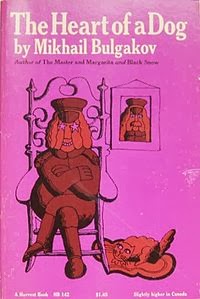
5/52: Heart of a Dog, by Mikhail Bulgakov
This author was recommended to me by a student. (At the beginning of every semester, I give a survey to my classes that asks them about their math backgrounds and their goals for the course, but also asks them for a movie/book recommendation for fun. I get a lot of interesting recommendations this way!) The library didn't have The Master & Margarita so I chose this instead. And I ended up reading it on two plane rides, to and from a conference. I don't believe I know enough about the historical aspects of the Russian revolutions to appreciate the allegorical aspects of the book, but I did enjoy the juxtaposition of deadpan realist narration with outlandish, gothic plot elements.
6/52: The Visible Man, by Chuck Klosterman
This was another quick read (two evenings). I'm already a Klosterman fan, but have mostly preferred his non-fiction work to, say, Downtown Owl (although I did like that one well enough). This one felt like a culmination of what Chuck is all about, what he's capable of, and what he goes for in his writing. I bet a lot of the characters and situations in this novel are based on people Chuck has known or, if not, things he has constructed in his head. This says several things about the man and his life: (i) he probably knows some fucked up people; (ii) he likely knows how to take fucked up stories and make them compelling and relatable; (iii) he might have a crazy imagination; and (iv) he possibly has an uncanny ability to make imaginative fiction into wholly believable storytelling. There are plentiful layers to the relationships and messages of this book, and I think part of the point is that we can forever debate them and never decide who is "right" and who is "lying" and who is "moral" and who is "crazy". This book is proof that you don't have to be overtly intellectual or dense or off-putting at all to be compelling, meaningful, and insightful.
This is where I am so far. Three weeks in, six books down. I like this pace, knowing that I can't keep it up; early in the semester, I hope to read as much as I feasibly can. Once March and April hit, I'll be in the mire of the spring semester. May and June will be better, and then I'm teaching again in July and August. So we'll see how this goes. I doubt I'll keep remotely close to a "one per week" average until the very end of the year.
Here's what I'm working on now:
A Clockwork Orange, by Anthony Burgess. Started this today, finally. Should be done this week. Compelling!
How to Travel with a Salmon, by Umberto Eco. A book I bought several months ago, read 10 pages of, and then abandoned. I'm starting it anew. A collection of humorous essays.
Gravity's Rainbow, by Thomas Pynchon. I haven't started this yet. But it's sitting by my recliner waiting. I don't often read very long fiction books, but when I do, I pick one and devote myself to it while keeping a couple of books going on the side. This is going to be my long fiction book for January/February. I'll start this weekend …
I've been reading a lot lately. By "a lot" I really mean "more than usual, on average over a given time frame, than in past years of my life". And by all of this I really mean that, over the last few months, I've found myself reading books (a) more often, (b) more voraciously, and (c) more sustainably than I usually do. I've enjoyed this trend quite a bit.
Last August, I started my first post-graduate school job. I'm now a mathematics instructor at a liberal arts college. This does not mean I find myself with more free time than in the past. (Despite what people say about graduate school, I think it's a great time to pursue hobbies and leisure activities; you just have to be more careful and adamant about managing your time.) If anything, quite the opposite. It's hard work fitting in to a new set of colleagues, working with an entirely new student body, managing expectations (both what you expect of your students and what they expect of you), and cultivating a social life, when you have time. But somehow, I've found myself with lots of time for pleasure reading.
Maybe it's just that I've finally decided, "I will make the time for pleasure reading. And I will do it often." I don't go to the movies. I don't go to bars on the weekends. I don't have cable. (I have a TV but haven't even bothered to put it up; even then, I'd likely only use it for DVDs and video games.) I don't follow sports. I don't mean to disparage these activities. Rather, I think these are activities that take up lots of time. Instead of doing those things, I find myself spending my time sitting in my recliner, putting an ambient record on the turntable (lately, it's been this one), and poring over a good book. And then another.
I've decided to track my progress through the literary landscape this year. More specifically, I've mentally committed myself to a "one book a week" journey. 52 weeks in a year. 52 books in a year. Sounds simple enough, no?
Thanks to the vacation time between the fall and spring semesters, I'm already well ahead of schedule. But I need this, because I presume the next few months will be all quiet on the reading front; once I have stacks of homework assignments to grade and class notes to prepare … I'll have ever-scanter time to devote to plowing through, say, The Brotherhood of the Grape. But the book will be there, beckoning me. So I'd like to use this as a public forum to not only make sure that I'm accountable to my commitment (like you give a shit, right?) but also to share my thoughts (like you give a shit, right?). Along with this, you can follow me on Goodreads.
With no more ados, here's what I've ingested so far:
1/52: Pym, by Mat Johnson
I started this when I was in NYC over New Year's and ended up finishing it on the bus ride back to Boston. I read it rather quickly, considering the length, and I'm sure this is due to the humor and pacing of the prose. It's meant to be fun, even though it's crazy. And racially-charged and, overall, demanding of your social attention. This was recommended to me by my mother because she was forced to read it for her job and she pretty much hated and found it weird and funky and, therefore, (quite correctly, mind you) presumed I would enjoy it. Keep 'em comin', mom.
2/52: The Fifth Child, by Doris Lessing
I took this out of my school's library after reading a headline that Lessing had passed away, back in November. I never knew of her during her life, but I figured now was as good a time as any to appreciate her writing. Not sure why I chose this particular novel; honestly, it was probably the slimmest novel in the library's collection. As it was, though, I sat down and finished this in one day. It's eerily gripping yet, even now weeks later, I'm not sure what to make of it. I think that's the point: so many circumstances tie us down and it's a daily/lifelong struggle to suss them out and prioritize. But it's never that simple either, even in retrospect.
3/52: Hyperbole and a Half: Unfortunate Situations, Flawed Coping Mechanisms, Mayhem, and Other Things That Happened, by Allie Brosh
Loved this. I mean, I already loved her blog and have been following for a while, but it was great to see things all together, in print, and read lots of new material. If you know this blog, then you've likely already read this book; if you don't know this blog, then you absolutely should. Here's why: 4/52: Zazie dans le Metro, by Raymond Queneau
I was tuned in to Queneau (and other Oulipo gangers) years ago by a friend. This particular book was purchased by me at a used book store years ago for the lowly sum of $5. This has to be one of my best used book finds of all time. This is an original 1959 Olympia Press printing, including delightful in-margin hand drawings by an illustrator and a lively dust jacket. (Consider this site, selling it for $48!) Forget the physicalities, though. This novel is delightful. Moreover, I marvel at the ingenious translation. The prose is as much about the use of Parisian and suburban/urban slang and wordplay as it is about a young girl and her uncle and their escapades in the city while the metro workers are on strike. I enjoyed this thoroughly, and aspire to know French well enough to read and appreciate this novel in its original version someday.
5/52: Heart of a Dog, by Mikhail Bulgakov
This author was recommended to me by a student. (At the beginning of every semester, I give a survey to my classes that asks them about their math backgrounds and their goals for the course, but also asks them for a movie/book recommendation for fun. I get a lot of interesting recommendations this way!) The library didn't have The Master & Margarita so I chose this instead. And I ended up reading it on two plane rides, to and from a conference. I don't believe I know enough about the historical aspects of the Russian revolutions to appreciate the allegorical aspects of the book, but I did enjoy the juxtaposition of deadpan realist narration with outlandish, gothic plot elements.
6/52: The Visible Man, by Chuck Klosterman
This was another quick read (two evenings). I'm already a Klosterman fan, but have mostly preferred his non-fiction work to, say, Downtown Owl (although I did like that one well enough). This one felt like a culmination of what Chuck is all about, what he's capable of, and what he goes for in his writing. I bet a lot of the characters and situations in this novel are based on people Chuck has known or, if not, things he has constructed in his head. This says several things about the man and his life: (i) he probably knows some fucked up people; (ii) he likely knows how to take fucked up stories and make them compelling and relatable; (iii) he might have a crazy imagination; and (iv) he possibly has an uncanny ability to make imaginative fiction into wholly believable storytelling. There are plentiful layers to the relationships and messages of this book, and I think part of the point is that we can forever debate them and never decide who is "right" and who is "lying" and who is "moral" and who is "crazy". This book is proof that you don't have to be overtly intellectual or dense or off-putting at all to be compelling, meaningful, and insightful.
This is where I am so far. Three weeks in, six books down. I like this pace, knowing that I can't keep it up; early in the semester, I hope to read as much as I feasibly can. Once March and April hit, I'll be in the mire of the spring semester. May and June will be better, and then I'm teaching again in July and August. So we'll see how this goes. I doubt I'll keep remotely close to a "one per week" average until the very end of the year.
Here's what I'm working on now:
A Clockwork Orange, by Anthony Burgess. Started this today, finally. Should be done this week. Compelling!
How to Travel with a Salmon, by Umberto Eco. A book I bought several months ago, read 10 pages of, and then abandoned. I'm starting it anew. A collection of humorous essays.
Gravity's Rainbow, by Thomas Pynchon. I haven't started this yet. But it's sitting by my recliner waiting. I don't often read very long fiction books, but when I do, I pick one and devote myself to it while keeping a couple of books going on the side. This is going to be my long fiction book for January/February. I'll start this weekend …
Labels:
52book,
a clockwork orange,
allie brosh,
book,
bulgakov,
burgess,
gravity's rainbow,
heart of a dog,
hyperbole and a half,
johnson,
klosterman,
lessing,
literature,
pym,
pynchon,
queneau,
visible man,
zazie
Subscribe to:
Posts (Atom)