A previous post of mine said that I will be reading 52 books in this year's 52 weeks. I have already surpassed this goal and have updated it to be 100(!) books this year. Here is my progress:
As of my most recent post, recapping April's readings, I had tallied 46 books. Here I am now to not only share my progress in the month of May, but also to up the ante a bit. Seeing that I hit 52 books not quite halfway through the year, and looking forward to the summer months with fewer daily commitments, I've decided to update my goal to 100 books this year. I'm well on my way and looking forward to more!
Here's what I've managed to ingest since my last update::
47/52: Random Essays on Mathematics, Education and Computers, by David G. Kemeny
As I noted in my Goodreads review, I highly recommend this book on its "Mathematics" and "Education" essays alone. You can skip the "Computers" section and not miss anything, but if you find yourself intrigued by what a 1960s mathematician predicted about the future of technology and its implementation, read away. There are so many quotable passages in this book, and its essays really resonated with many of viewpoints on math and undergraduate education. It seems to be a bit of a rare book, too, having been published by the MAA back in the day and not available anywhere else. (Indeed, I had to add the book to Goodreads myself.)
48/52: Paperweight, by Stephen Fry
I love Stephen Fry. I bubble and burst with sickly sweet love for him. (I hope I'm doing his enthusiasm for wordsmithery veritable justice here.) This is a collection of various newspaper articles, radio scripts, and even a play he wrote, which you cannot find published elsewhere. If you're a Fry fan already, this is an absolute "must read" and is highly recommended. I admittedly skimmed through one small section that contained a bunch of reviews of books by British authors I'd never heard of. But I devoured thrice over some of his more penetrable essays, including a delightfully memorable one about the word "fuck" and its usage. I cannot imagine such a writeup appearing in a national American newspaper. God bless ye Britons.
49/52: Attempting Normal, by Marc Maron
I started listening to this as an audiobook, at first. As a reasonably avid listener to Maron's WTF Podcast, I looked forward to hearing his voice read these words. A confluence of three factors led me to eventually read this in print form, after listening to only the first chapter: (1) my audiobook app's innate volume is set irrevocably low, and a passing car renders words completely out of earshot, despite an earbud set firmly in the requisite orifice; (2) I realized that I'm so accustomed to Maron's voice, tone, and cadences, that I can read his printed words "aloud" in my head effectively without his intervention; and (3) I stumbled on a hardcover copy of this in the library. So, I read it. It was good. If you are, as well, a Maron fan, then this is another "must read". Even if you're not, though, this is a well-written memoir of a life in comedy and … well, a life in life.
50/52: Blind Willow, Sleeping Woman, by Haruki Murakami
I've only read one short novel by Murakami before. I'm admittedly daunted by the thickness of, say, IQ84. So I dabbled with After Dark, and now with this collection of short stories. But they're so damn great. I have to read more. Murakami finds a way to describe and make wholly interesting the inner workings of a character's mind, without literally writing about their thoughts or emotions. This is hard to describe, I'm realizing now. You just have to read him. I plan on delving into more of his oeuvre in the very near future.
51/52: Slaughterhouse-five, by Kurt Vonnegut
I bought a used copy of this book a few years ago but only just read it now. I'm glad I did. It was a quick read (two days or so) and totally worth it. I believe I need to reread this again to fully understand its satirical aspects and appreciate its place in the canon of American literature. But I'll be damned if I didn't laugh out loud at parts of this, while scratching my head at others. What else can you ask for from a novel?
52/52: Primates: The Fearless Science of Jane Goodall, Dian Fossey, and Biruté Galdikas, by Jim Ottaviani & Maris Wicks
I've found many interesting books while perusing the graphic novel section of the Boston Public Library. This is definitely one of those books. Everyone "knows" Jane Goodall, and maybe even Dian Fossey, but I'd argue that very few people really know what they did and why they did it and what it all means. This book addresses that. What's more, it does so in a wholly engaging manner and can even appeal to a variety of audiences. I was totally engrossed by this book, and I can imagine a 13-year-old, say, similarly engaged. That says a lot about the way that Ottaviani crafted the story and Wicks drew the panels, but it also says a lot about the reality interweaving these three tenacious scientists. Let alone that they're all females and they all studied primates; this is just a damn good story.
53/100: Moab Is My Washpot, by Stephen Fry
Ah yes, more of Mr. Fry. I knew absolutely none of this about the man. This is the story of his life from age 0ish to 18ish. It is incredibly forthright and arguably confrontational in how frank it is. But it wholly succeeded, for me, in describing and motivating who this man has become. I like to think I understand Mr. Fry a lot more, having read this; yet, having read this, I'm sure that he will continue to surprise me.
54/100: Alex, by Mark Kalesniko
A graphic novel about an "artist's" "struggle" in suburbia. I liked a lot of aspects of this book. The drawing style might be the selling point. It was both sparse and evocative; pure black and white with lots of shading and interesting vantage points. Considering the various scenes in the book took place in only a handful of places, I was actually quite impressed with the variety in rendering. The characters were well-developed and their interactions were rich. And the overt John Fante reference was a nice touch. (The action took place in Bandini, CA.) However, the story was a little trite, or at least frequently-enough-played-out-to-be-almost-unengaging. I dunno. I was just thinking, "Oh, a frustrated artist is a drunk still living in his hometown and thrashing against his adolescent influences? How original!" I fully enjoyed the read at the time, but it is what it is.
55/100: Ezra Pound: Early Poems, by Ezra Pound
(This was a short book of poetry, but I'm including it amongst the other books in the "Other readings that count" section below to register as a full "read" here.) I picked this out during April (poetry month) since Ezra Pound attended my undergraduate institution. (At the same time, I picked out a collection of poetry by Robert Lowell, who attended my high school. I'm still reading that one.)
I remember trying to dive into some of Pound's Cantos a few years back and getting nowhere rapidly. This collection was a bit more inviting. Some of these poems were wholly forgettable, while others were immediately engaging. Overall, I could sense and appreciate Pound's style. His ability to conjure images and make them profound is commendable. After this, I'd like to go back and read more of his poetry. I don't know what it will do for me, but this particular collection has certainly motivated those efforts.
56/100: Dead Fish Museum, by Charles D'Ambrosio
More genuinely sad stories from a modern short story genius. Still though, it's difficult to characterize what makes these stories sad, let alone great. Nothing is overtly depressing. It's something about D'Ambrosio's ability to craft a character and, more importantly, a character's feeling of their environment. There's one story I have in mind where a guy just moved into a new house with his wife. I recall little about the scenery, save for a tree in the backyard and the house's isolation from the rest of the town. But I can vividly evince this man's emotional reactions to the house at night, to the creakings of its floors when family visited, to its view of the nearby trees and rivers. I can't think of anyone else's writing that has this effect on me. I'm glad I discovered this writer this year.
57/100: Sleepwalk With Me, by Mike Birbiglia
I'm already a fervent Birbiglia fan. (He also attended my high school, and even grew up in my hometown.) I also saw the film he created from this book already. But I spotted this on the library shelves and realized I had to read it. I knew many of the jokes, from Mike's standup and the film. But everything carries through so well. These are heartfelt and undeniably honest stories. Mike is a great storyteller. And you are a human being, not a robot. So you get drawn in. Right? RIGHT?
58/100: Mathematical Lives: Protagonists of the 20th Century, edited by Claudio Bartocci et al.
One of the few books by which I've been genuinely disappointed :-( The goal of this collection, I gathered, is to share essays about the most interesting/notable entities in 20th century mathematics. I love this goal. And any support I show towards this book is purely based on how much they attempted to advance this goal, not how much they actually achieved towards this goal. Here are my criticisms: (1) The diversity in this book is frighteningly nonexistent. There may have been one woman mentioned. I can't even recall. No other races mentioned. They're all white men from America or Western Europe/England, plus a handful of Russians and Hungarians. What gives? (2) Amongst those that are mentioned, the essays are poorly written. "Granted", these are mostly translated from Italian (I gather, based on the editors' names) but still … there are entire nonsensical paragraphs and piss-poor sentences/vocabulary. (3) The variability is confusing. Some entries merit an eight-page essay with interview excerpts, while others garner only two pages of curt discourse. I cannot ascertain any reason for the distinctions either.
I think this book could really succeed. I wish it was better at what it tried to do. But, ultimately, this book sucks.
59/100: Chess Story and Journey Into The Past, by Stefan Zweig
I stumbled into Zweig's writings after watching The Grand Budapest Hotel in the theatre recently. (By the by, that was a great film. I'm a Wes Anderson fan, and this is also already one of my favorites of his.) The end credits declare that the script was "inspired by" the writings of Stefan Zweig. Bien sur, I checked him out at the library. I read these two novellas in a two-week span and thoroughly enjoyed them both. Indeed, I can even see the influence they might have had on Mr. Anderson's film. "Chess Story" was certainly my favorite. The "story within a story" aspect evokes the Budapest plot, and the emotional ties of Past evoke some of the film's plot elements. But forget about Anderson. These are great writings, and I would find them wholly enjoyable without the backstory of my discovery of them.
60/100: The Journey To The East, by Hermann Hesse
Not as good as Siddhartha. I enjoyed this very much but "understand" much less about it than I did about Hesse's other novella. What am I missing? Am I being too critical? Did I miss out on much of the religious allegory? Both? I bet it's both.
61/100: The End Of Your Life Book Club, by Will Schwalbe
A recommended read from my mom. I sat down and read this over a two-day period while visiting my parents. I enjoyed reading this mostly for the emotional sway of the story (not so much the events), but equally as much for the recommended reading list that it generated. Indeed, the author included a multi-page list in an appendix containing all the books/authors mentioned in the text. I've already been using this as a recommendation engine, quite effectively!
62/100: Feynman, by Jim Ottaviani & Leland Myrick
I sought this out after reading the Primates book, also written (but not drawn) by Ottaviani. I knew a bit about Feynman's life, having studied physics and read a couple of his books, but this book introduced to much more of Feynman's life story than I thought imaginable in 200ish pages of comic panels. I got a sense of the man's life and personality, but I fear that this is partly because I already had an introduction to him. I wonder what a genuine Feynman n00b would get out of this. But, hey, I suppose that's not the intended audience.
63/100: The Body Artist, by Don DeLillo
I cite DeLillo as one of my favorite modern writers, but this is the most recent work of his that I've read. I enjoyed this metaphysical novella about dance, emotional commitment, mourning, human compassion, and more … I was pushed and prodded and intrigued. But, ultimately, this makes me want to go back and reread White Noise.
64/100: The Reluctant Fundamentalist, by Mohsin Hamid
This is one of those "recommended reads" from the book above, The End Of Your Life Book Club. I'm glad I listened to the recommendation! This was great. I still feel the ending is ambiguous; I know that's the point, but I also haven't been able to decide either way which one I believe/prefer/understand/advocate/blah. This was very well-executed and highly recommended to modern readers.
65/100: I Wear The Black Hat: Grappling With Villains, by Chuck Klosterman
Catching up on Klosterman. (I think Eating the Dinosaur is the only one I haven't read yet!) This is better than much of his recent non-fiction. I particularly enjoyed Chuck injecting himself, and his self-perception, into the text. I know that this could be purely sensational, but it worked. And I do believe it. I especially like thinking about him simultaneously working on The Visible Man. I was asked recently by a friend about my favorite book of this year, and I cited that novel< The Visible Man. I couldn't explain why, but after reading this non-fiction book about evil, and contemplating Klosterman's multi-year study of evil and covert observation, and considering him as an observer of human nature and culture, and … well, a whole bunch of stuff … Considering all that shit, I found this book fascinating. Disregarding all of that shit, I bet this would still be fascinating.
66/100: The Moon and Sixpence, by W. Somerset Maugham
Genuinely one of the best fiction novels I've read this year! And yet, I've learned that this is "merely" a roman á clef, meant to describe the life and times of French painter Paul Gauguin. I stumbled into this by learning of the writer, W. Somerset Maugham, via the aforementioned book-club-vehicle, The End Of Your Life Book Club. I sought out the MAU fiction section in the library, read some dust-jackets, and chose this book. I made the right choice. This is brilliantly-written, is funny and poignant and emotionally-engaging, and serves to foster an interest in both Maugham and Gauguin. I look forward to going back to the Boston Museum of Fine Arts to see his painting, D'où Venons Nous / Que Sommes Nous / Où Allons Nous ; I've already seen it a handful of times, but I look forward to viewing it with newfound appreciation, after learning about Gauguin's life and times.
Other readings that count:
Coffee With Isaac Newton, by Michael White:
I stumbled upon this in the "science" section at the library. It's a noble pursuit, but falls far short. I bet it's difficult to mimic Newton, of course, but this is not even an interesting quasi-mimicry. I don't want to argue that Newton is more combative but … I'm sure he is. This could be a completely different work without sacrificing accuracy.
2013: Best New Poets, edited by Brenda Shaughnessy:
I'm glad I picked this up and explored it. I don't think I got a good sense of where poetry is "going" currently, but I suppose that isn't the point. Some of these were engaging and wonderful, many were entirely forgettable, and a scant handful were downright awful. So it goes. I could do no better. I'll look for more from this series.
Long Live Man, by Gregory Corso:
More vestiges of "poetry month" from April. I explored Corso a lot, thinking of his eponym on the Sonic Youth song on their "final" (gasp!) album, The Eternal. This was all well and good, and made me want to explore more.
Up next:
In the Shadow of Man, by Jane Goodall:
I even mentioned this last month, but have yet to act on it. Here I go! I want to learn more about Jane and her work with primates. Will do.
Why Public Higher Education Should Be Free, by Robert Samuels:
Admittedly, a sensational title, but that's exactly what caught my eye in the "current non-fiction" section at BPL. Working in higher education makes me even more apt to pick this up to read.
Pawnee: The Greatest Town In America, by Leslie Knope:
Found in the comedy/TV/film section at the library. I also recall seeing a YouTube video recently that is an interview of the cast/crew/writers of Parks & Rec wherein a writer admits that, after they wrote this book, they consult it regularly to make sure facts are consistent; they realize fans will call them out on shit, so they have to check!
Dad Is Fat, by Jim Gaffigan:
Listening to this on audiobook. About halfway done.
Decline and Fall, by Evelyn Waugh:
Picked this up after watching a Stephen Fry "lecture" at Sydney Opera House wherein he mentions three Ws: Wilde, Waugh, Wodehouse. I've read much of Wodehouse, and just yesterday finished The Importance of Being Earnest, but I'm a Waugh virgin.
A convenient place for me to unload scoops of metaphorical brain matter. The title refers to a book of poetry by Charles Bukowski.
Showing posts with label reading. Show all posts
Saturday, June 7, 2014
52 Books - May update: 66/100
Labels:
52book,
book,
charles d'ambrosio,
delillo,
ezra pound,
feynman,
gauguin,
hesse,
jane goodall,
klosterman,
marc maron,
math,
maugham,
mfa,
mike birbiglia,
reading,
stefan zweig,
stephen fry,
vonnegut,
wes anderson
Friday, May 2, 2014
52 Books - March update (belated, obvi): 37/52
A previous post of mine said that I will be reading 52 books in this year's 52 weeks. I fully intend to achieve that goal. Here is my progress:
As of last post, I had 21 books down and felt like (a) I was ahead of pace yet (b) I wouldn't be able to keep it up. Here we are, well into April and I am even further ahead of schedule and show no signs of slowing. The first and second derivatives of Reading(x) appear to be positive!
In March, I did the following:
Here's what I've managed to ingest since my last update::
22/52: Don't Kiss Me: Stories, by Lindsay Hunter
Here's the review of this book I wrote on Goodreads:
23/52: The Squirrel Mother: Stories, by Megan Kelso
This was mediocre, at best. Looking back, a few weeks removed, I recall a great story about Benjamin Franklin (I think?) and a terribly-told story about being left home alone by an aunt suffering from depression. There might have been another story about democracy and voting … maybe not. But this one just doesn't stick out. I was intrigued by the visuals of this book: seeing the cover and skimming through it at least made me check it out from the library, but after that … I checked out. Not boring, not offensive, not poor writing. Just all-around plain.
24/52: Wait Until Spring, Bandini, by John Fante
The final part of the Bandini series that I read over the last few months. This was the part I don't own a copy of, and I only found it in the library (and subsequently decided to read it) because I was already nearby in the fiction section. Strangely, I'm both upset and happy that this is one of the last Bandini saga entries I've ever read. This lends many insights into the Arturo Bandini character, of course, since this is the story of his upbringing. But I also kinda loved knowing Bandini as he was, not knowing where he came from, trying to reconstruct a past that would lead to his life; I thought of his parents and siblings and hometown through his own eyes and mind and narration. And now, well, I kinda still think that way, but I have his own personal narration to add to that. And it's great but also redundant. Yes, I'm talking as if I know this guy. Bye.
25/52: Beg The Question, by Bob Fingerman
I picked this one up from the library based on the cover and skimming through some pages. It looked like it would be funny and enjoyable and not a "flimsy read", so to speak. I wasn't wrong. Mostly, I enjoyed the characters in this story. They were well-developed, both personality-wise and artistically (in the graphics sense), and their interactions led to many funny and poignant situations. I couldn't really relate to them historically or situationally, so this novel only succeeded partially, in terms of those goals. But that wasn't the point, right? I enjoyed the read well enough.
26/52: An Invisible Thread, by Laura Schroff
I borrowed this book from my mom because she recommended I read it. So I did. Who am I to disobey? It was, indeed, a heart-warming tale of unlikely friendship, charity, perseverance, personality, and urban history. But it felt un-representative of the true story. It was half of the story, really. It entirely lacked the viewpoint of the male protagonist, whose name I've even forgotten by now, eve though he's the whole point of the story and the book, and even though I still somehow know that the writer's name is Laurie Schroff and she worked in advertising at USA Today when it was a big deal to get businesses to advertise in that paper and … ugh, I'm actually liking this book less and less the more I think about it. Too much of a mass-market fiction style to appeal to me, but, what's even worse, it tried so hard to be in that style.
27/52: Wise Blood, by Flannery O'Connor
I watched the film adaptation of this book a few years ago and enjoyed it. It was a well-made film and stands on its own. But I'm quite glad I read the novel, too. I don't intend this to contribute to the "Oh man, the book is always way better"-style debate. Rather, I'm pointing out that I'm glad I experienced both. They each have their merits. The cinematography of the film was so stark and gritty and sharp that, as I read the novel, still scenes from the film shot into my head. Facial expressions of the main characters stuck in my mind as I read about them. Meanwhile, a whole universe of interaction opened up as I read the narration and explored the characters in more depth than the visuals and dialogue could possibly convey. Between these two, I feel more experienced about this world that O'Connor established. I have no desire to live in that world. At all. But it was fascinating to enter for a few days.
28/52: The Mathematical Magpie, editor: Clifton Fadiman
More mathematical stories, essays, excerpts, poems, and short writings. Also collected and edited by Clifton Fadiman, in addition to Fantasia Mathematica, which I read a few months ago. This book is chock full of fun math stuff, and I have sticky notes fanning out from many of its pages. I'd love to see this kind of series continued for a more contemporary audience.
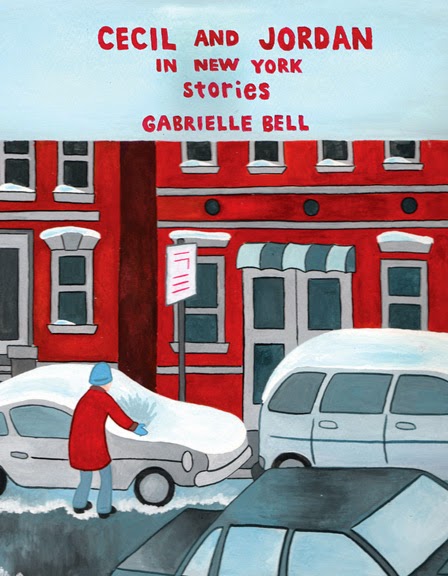
29/52: Cecil & Jordan in New York, by Gabrielle Bell
I've read a few of Bell's works recently. This one is a sequence of short stories about New York life and adventures. I think I prefer her more autobiographical works, and I guess I couldn't tell with many of the stories in this book whether or not they're personal stories. The drawings are great, and the story-telling is pretty good, but it didn't add up to a captivating reading experience, for me.
30/52: All & Sundry: Uncollected Work (2004-2009), by Paul Hornschemeier
More exploration of Hornschemeier's works. This one truly is all and sundry and collected and uncollected. I laughed out loud at many of these stories and drawings. I shed some tears at others. I scratched my head and beard with others. And some I just skimmed right through and couldn't cohesively consider. Certainly, highly recommended for the aspiring conoisseur of modern graphic novelism, but not at all for anyone else.
31/52: Mother Come Home, by Paul Hornschemeier
Oy, more Hornschemeier and more crying. How does he do it? This one was depressingly heart-wrenching but I couldn't put it down. I seriously remember sitting around reading some pages in this, slamming the book closed, tossing it on the ground, and saying out loud, "God damnit, man." And sighing loudly. And taking another sip of wine. And then another. And then picking up the book enthusiastically again. Because I just couldn't avoid reading more.
32/52: Uncharted: Big Data as a Lens on Human Culture, by Erez Aiden & Jean-Baptiste Michel
Really well-written. It's great to see some modern science/math/tech people who can appeal to broad audiences, tell good stories, and write in an engaging and intelligent way without sacrificing truth and rigor, ultimately. In particular, this book left me wondering about a lot of interesting questions and made me feel inspired to explore them and do some science. If you haven't explored it before, you need to play around with Google's NGram viewer. The authors of this book are its creators and they describe its genesis and uses extensively in this book. Highly recommended, to anyone.
33/52: The Voyeurs, by Gabrielle Bell
More Gabrielle Bell and, looking back, most likely my favorite collection of hers. These stories are more interesting and better told than those in her other books, I think. I particularly liked the diary-style aspect of this one, at least for part of it. If you're looking to explore her work, I'd start here.
34/52: Best American Comics: 2009, editors: Charles Burns, Jessica Abel, Matt Madden
Lots of good comics in here. Lots of weird shit, too. A smattering of so-so stuffing. I will happily explore more entries in this series, with the understanding that I'll likely get more of the same: a few things I'll love, a glut of things I'll find okay, and some stuff I'll flip through quickly. You should expect the same.
35/52: The Point: Stories, by Charles D'Ambrosio
I totally forget how D'Ambrosio entered my cultural consciousness, but here he is, fully formed. And I'm glad. These stories are … well, not outright depressing, but they make no pretense of being otherwise. I read through these one by one and required hours- to days-long reading breaks in between them. Dense and rich with emotional intensity, these are. I'll recommend if you're looking for something potentially engaging but also potentially overpowering. You've been goaded, and warned.
36/52: First Thought, Best Thought: The Art of Spontaneous & Inspired Writing Taught by Four Legendary Mentors of the Craft, by Allen Ginsberg, Anne Waldman, William S. Burroughs, Diane Di Prima
I've starting exploring audiobook titles through the OverDrive app. (Through your local library, you can log in and download various ebooks and audiobooks! It's very convenient.) This one is a recording of four lectures by some Beat-generation writers about their methods and history, for an audience at a writing school, over the years. Allen Ginsberg's lecture was about rhythm and meter in poetry and, despite my boring description, was actually quite fascinating. He's a dynamic speaker. William Burroughs spoke about his "cutting" technique of splicing together words from literal newspaper clippings and the like. It was inspiring, but I've yet to do anything about it. Diane DiPrima spoke about printing presses and properly distributing one's work. It was fine, but she came across as a bit of an unrelenting Luddite, although I think that was part of her point. I don't even remember who the fourth speaker was, alas, which says something about how interesting her lecture was. (Yes, I looked the name up to title this one, but otherwise couldn't remember.) Anyhow, consider checking this out if you fancy yourself a writer, or if you are a fan of Ginsberg/Burroughs/DiPrime/what's-her-name. Otherwise, don't bother.
37/52: The Perks of Being a Wallflower, by Stephen Chbosky
I picked this movie up from the public library a few weeks back, for whatever reason. The name jumped out at me from the DVD's spine as I scanned across the P section, and I remembered the hype around it being filmed in Pittsburgh a few years ago when I was there. So I watched it, having no real idea of what it was about, except for some sort of "coming of age" story. There's more to it than that. I ended up enjoying the film, for what it was, and decided I should read the novel, too. So I did. It was a quick read, only a day or two, including reading the entire second half in one sitting over dinner and a couple of drinks one evening. I still don't know think I know what to make of it, but I found it an enjoyable read. It's tough to entirely relate to any of the characters, but I'm not sure what that means. Maybe that's not the goal.
Other readings that kinda count:
The Lagoon, by Lili Carré:
A haunting graphic novel that I thoroughly enjoyed. This was a quick read, so I paired it with one of the above Hornschemeier books to "count" as a read.
Mr Wonderful, by Daniel Clowes:
A graphic short story I found and read entirely inside the library. The shape of the book and imagery on the cover caught my eye, so I took it to a table and ended up reading it in about half an hour. Enjoyable, and will look for more of Clowes' work in the future.
The Ideal Teacher, by George Hebert Palmer:
Recommended read from my mother. She has a physical copy of this book which she received as a gift from a former student of hers. It's a veritable relic, yet very little of the author's message is without meaning today. I found this to be a great essay from an educator about education, and it behooves modern educators to read it and reflect on just how much of the author's message still applies.
Kids Are Weird, by Jeffrey Brown:
A fun read that shows how … well, the minds of children will spew forth weird, seemingly random thoughts that make us smile, chuckle, and shake our heads. I can't wait to have kids so I can (a) mess with them, (b) teach them things, and mostly, as this book points out, (c) serve as a vessel/recorder for the truly crazy shit they will inevitably say/do.
The Wrong Place, by Brecht Evans:
Loved the watercolor aspects of this work. Every other graphic novel I've read stresses the ink lining, the comic-strip-style depiction of persons, the sharp contrast between image and text. This one blurs all of those lines and curves, and I loved it for that. The story, itself? Meh. But the format was superb.
Up next:
I will not fill in this section because, well, it's already May and telling you about books I was going to start reading in early April is pointless since I have, by now, already finished most of those anyway.
That said, I will be posting the April update of this series later tonight or tomorrow, so there's no need to worry. Not that you were, anyway. kthxbye
As of last post, I had 21 books down and felt like (a) I was ahead of pace yet (b) I wouldn't be able to keep it up. Here we are, well into April and I am even further ahead of schedule and show no signs of slowing. The first and second derivatives of Reading(x) appear to be positive!
In March, I did the following:
- I read some collections of short stories, one by an author I know and love and others by totally new (to me) authors.
- I explored the bibliographies of several graphic novelists I've come to admire, including Paul Hornschemeier, Gabrielle Bell, and Jason.
- I read (and am reading) a few non-fiction books, especially about areas outside of mathematics.
- I watched a film and then went back to read the novel on which it was based.
- I wrote an essay for a forthcoming zine about Pittsburgh, and this reawakened a desire for writing in my own life. To wit …
- I brainstormed some ideas for math books that I want to write, if I ever have the time.
- I thought a lot about education and have some ideas for essays I want to write but no idea where to share them.
- Most of all, I filled any spare moments I had between teaching, planning classes, grading, and walking/sleeping/eating/cooking by just sitting in my recliner with a soothing record on the player and propping open a book. If the rain was pattering, I'd keep the door open for a soundtrack. And I'd read.
Here's what I've managed to ingest since my last update::
22/52: Don't Kiss Me: Stories, by Lindsay Hunter
Here's the review of this book I wrote on Goodreads:
I have to be in a certain mood to read Lindsay Hunter's stories, and I have to know ahead of time that they'll leave me in a certain mood afterwards. I still don't know what these stories "mean", but that's decidedly not the point with her prose. The process of reading, of twisting her words through my mouth and my brain, is the entire joy.Yup, that's right. Try reading one of Lindsay's stories. You'll experience one of the following emotion/reaction combinations: "This is incredibly weird! I want to read more!"; "This is incredibly weird! What the fuck is this? I'll come back to this later."; "This is incredibly weird! I can't read any more of this."; "Qu'est-ce que c'est ici? C'est si bizarre!" Personally, I read each one and then put the book down on my lap and say, "What the fuck was that?" And then I chuckle out loud, and then I pick the book up again and read another story. That's just how our relationship is, and it's how I want it to be.
23/52: The Squirrel Mother: Stories, by Megan Kelso
This was mediocre, at best. Looking back, a few weeks removed, I recall a great story about Benjamin Franklin (I think?) and a terribly-told story about being left home alone by an aunt suffering from depression. There might have been another story about democracy and voting … maybe not. But this one just doesn't stick out. I was intrigued by the visuals of this book: seeing the cover and skimming through it at least made me check it out from the library, but after that … I checked out. Not boring, not offensive, not poor writing. Just all-around plain.
24/52: Wait Until Spring, Bandini, by John Fante
The final part of the Bandini series that I read over the last few months. This was the part I don't own a copy of, and I only found it in the library (and subsequently decided to read it) because I was already nearby in the fiction section. Strangely, I'm both upset and happy that this is one of the last Bandini saga entries I've ever read. This lends many insights into the Arturo Bandini character, of course, since this is the story of his upbringing. But I also kinda loved knowing Bandini as he was, not knowing where he came from, trying to reconstruct a past that would lead to his life; I thought of his parents and siblings and hometown through his own eyes and mind and narration. And now, well, I kinda still think that way, but I have his own personal narration to add to that. And it's great but also redundant. Yes, I'm talking as if I know this guy. Bye.
25/52: Beg The Question, by Bob Fingerman
I picked this one up from the library based on the cover and skimming through some pages. It looked like it would be funny and enjoyable and not a "flimsy read", so to speak. I wasn't wrong. Mostly, I enjoyed the characters in this story. They were well-developed, both personality-wise and artistically (in the graphics sense), and their interactions led to many funny and poignant situations. I couldn't really relate to them historically or situationally, so this novel only succeeded partially, in terms of those goals. But that wasn't the point, right? I enjoyed the read well enough.
26/52: An Invisible Thread, by Laura Schroff
I borrowed this book from my mom because she recommended I read it. So I did. Who am I to disobey? It was, indeed, a heart-warming tale of unlikely friendship, charity, perseverance, personality, and urban history. But it felt un-representative of the true story. It was half of the story, really. It entirely lacked the viewpoint of the male protagonist, whose name I've even forgotten by now, eve though he's the whole point of the story and the book, and even though I still somehow know that the writer's name is Laurie Schroff and she worked in advertising at USA Today when it was a big deal to get businesses to advertise in that paper and … ugh, I'm actually liking this book less and less the more I think about it. Too much of a mass-market fiction style to appeal to me, but, what's even worse, it tried so hard to be in that style.
27/52: Wise Blood, by Flannery O'Connor
I watched the film adaptation of this book a few years ago and enjoyed it. It was a well-made film and stands on its own. But I'm quite glad I read the novel, too. I don't intend this to contribute to the "Oh man, the book is always way better"-style debate. Rather, I'm pointing out that I'm glad I experienced both. They each have their merits. The cinematography of the film was so stark and gritty and sharp that, as I read the novel, still scenes from the film shot into my head. Facial expressions of the main characters stuck in my mind as I read about them. Meanwhile, a whole universe of interaction opened up as I read the narration and explored the characters in more depth than the visuals and dialogue could possibly convey. Between these two, I feel more experienced about this world that O'Connor established. I have no desire to live in that world. At all. But it was fascinating to enter for a few days.
28/52: The Mathematical Magpie, editor: Clifton Fadiman
More mathematical stories, essays, excerpts, poems, and short writings. Also collected and edited by Clifton Fadiman, in addition to Fantasia Mathematica, which I read a few months ago. This book is chock full of fun math stuff, and I have sticky notes fanning out from many of its pages. I'd love to see this kind of series continued for a more contemporary audience.
29/52: Cecil & Jordan in New York, by Gabrielle Bell
I've read a few of Bell's works recently. This one is a sequence of short stories about New York life and adventures. I think I prefer her more autobiographical works, and I guess I couldn't tell with many of the stories in this book whether or not they're personal stories. The drawings are great, and the story-telling is pretty good, but it didn't add up to a captivating reading experience, for me.
30/52: All & Sundry: Uncollected Work (2004-2009), by Paul Hornschemeier
More exploration of Hornschemeier's works. This one truly is all and sundry and collected and uncollected. I laughed out loud at many of these stories and drawings. I shed some tears at others. I scratched my head and beard with others. And some I just skimmed right through and couldn't cohesively consider. Certainly, highly recommended for the aspiring conoisseur of modern graphic novelism, but not at all for anyone else.
31/52: Mother Come Home, by Paul Hornschemeier
Oy, more Hornschemeier and more crying. How does he do it? This one was depressingly heart-wrenching but I couldn't put it down. I seriously remember sitting around reading some pages in this, slamming the book closed, tossing it on the ground, and saying out loud, "God damnit, man." And sighing loudly. And taking another sip of wine. And then another. And then picking up the book enthusiastically again. Because I just couldn't avoid reading more.
32/52: Uncharted: Big Data as a Lens on Human Culture, by Erez Aiden & Jean-Baptiste Michel
Really well-written. It's great to see some modern science/math/tech people who can appeal to broad audiences, tell good stories, and write in an engaging and intelligent way without sacrificing truth and rigor, ultimately. In particular, this book left me wondering about a lot of interesting questions and made me feel inspired to explore them and do some science. If you haven't explored it before, you need to play around with Google's NGram viewer. The authors of this book are its creators and they describe its genesis and uses extensively in this book. Highly recommended, to anyone.
33/52: The Voyeurs, by Gabrielle Bell
More Gabrielle Bell and, looking back, most likely my favorite collection of hers. These stories are more interesting and better told than those in her other books, I think. I particularly liked the diary-style aspect of this one, at least for part of it. If you're looking to explore her work, I'd start here.
34/52: Best American Comics: 2009, editors: Charles Burns, Jessica Abel, Matt Madden
Lots of good comics in here. Lots of weird shit, too. A smattering of so-so stuffing. I will happily explore more entries in this series, with the understanding that I'll likely get more of the same: a few things I'll love, a glut of things I'll find okay, and some stuff I'll flip through quickly. You should expect the same.
35/52: The Point: Stories, by Charles D'Ambrosio
I totally forget how D'Ambrosio entered my cultural consciousness, but here he is, fully formed. And I'm glad. These stories are … well, not outright depressing, but they make no pretense of being otherwise. I read through these one by one and required hours- to days-long reading breaks in between them. Dense and rich with emotional intensity, these are. I'll recommend if you're looking for something potentially engaging but also potentially overpowering. You've been goaded, and warned.
36/52: First Thought, Best Thought: The Art of Spontaneous & Inspired Writing Taught by Four Legendary Mentors of the Craft, by Allen Ginsberg, Anne Waldman, William S. Burroughs, Diane Di Prima
I've starting exploring audiobook titles through the OverDrive app. (Through your local library, you can log in and download various ebooks and audiobooks! It's very convenient.) This one is a recording of four lectures by some Beat-generation writers about their methods and history, for an audience at a writing school, over the years. Allen Ginsberg's lecture was about rhythm and meter in poetry and, despite my boring description, was actually quite fascinating. He's a dynamic speaker. William Burroughs spoke about his "cutting" technique of splicing together words from literal newspaper clippings and the like. It was inspiring, but I've yet to do anything about it. Diane DiPrima spoke about printing presses and properly distributing one's work. It was fine, but she came across as a bit of an unrelenting Luddite, although I think that was part of her point. I don't even remember who the fourth speaker was, alas, which says something about how interesting her lecture was. (Yes, I looked the name up to title this one, but otherwise couldn't remember.) Anyhow, consider checking this out if you fancy yourself a writer, or if you are a fan of Ginsberg/Burroughs/DiPrime/what's-her-name. Otherwise, don't bother.
37/52: The Perks of Being a Wallflower, by Stephen Chbosky
I picked this movie up from the public library a few weeks back, for whatever reason. The name jumped out at me from the DVD's spine as I scanned across the P section, and I remembered the hype around it being filmed in Pittsburgh a few years ago when I was there. So I watched it, having no real idea of what it was about, except for some sort of "coming of age" story. There's more to it than that. I ended up enjoying the film, for what it was, and decided I should read the novel, too. So I did. It was a quick read, only a day or two, including reading the entire second half in one sitting over dinner and a couple of drinks one evening. I still don't know think I know what to make of it, but I found it an enjoyable read. It's tough to entirely relate to any of the characters, but I'm not sure what that means. Maybe that's not the goal.
Other readings that kinda count:
The Lagoon, by Lili Carré:
A haunting graphic novel that I thoroughly enjoyed. This was a quick read, so I paired it with one of the above Hornschemeier books to "count" as a read.
Mr Wonderful, by Daniel Clowes:
A graphic short story I found and read entirely inside the library. The shape of the book and imagery on the cover caught my eye, so I took it to a table and ended up reading it in about half an hour. Enjoyable, and will look for more of Clowes' work in the future.
The Ideal Teacher, by George Hebert Palmer:
Recommended read from my mother. She has a physical copy of this book which she received as a gift from a former student of hers. It's a veritable relic, yet very little of the author's message is without meaning today. I found this to be a great essay from an educator about education, and it behooves modern educators to read it and reflect on just how much of the author's message still applies.
Kids Are Weird, by Jeffrey Brown:
A fun read that shows how … well, the minds of children will spew forth weird, seemingly random thoughts that make us smile, chuckle, and shake our heads. I can't wait to have kids so I can (a) mess with them, (b) teach them things, and mostly, as this book points out, (c) serve as a vessel/recorder for the truly crazy shit they will inevitably say/do.
The Wrong Place, by Brecht Evans:
Loved the watercolor aspects of this work. Every other graphic novel I've read stresses the ink lining, the comic-strip-style depiction of persons, the sharp contrast between image and text. This one blurs all of those lines and curves, and I loved it for that. The story, itself? Meh. But the format was superb.
Up next:
I will not fill in this section because, well, it's already May and telling you about books I was going to start reading in early April is pointless since I have, by now, already finished most of those anyway.
That said, I will be posting the April update of this series later tonight or tomorrow, so there's no need to worry. Not that you were, anyway. kthxbye
Labels:
52book,
beat generation,
big data,
burroughs,
clifton fadiman,
film,
flannery o'connor,
gabrielle bell,
ginsberg,
john fante,
lindsay hunter,
paul hornschemeier,
reading,
writing
Saturday, February 1, 2014
52 books - January update: 10/52
My previous post said that I will be reading 52 books in this year's 52 weeks. I fully intend to achieve that goal. Here is my progress:
As of last post, I had 6 books down and now, by the end of January, I have 10 under my proverbial belt. Huzzah! I am trying to take as much advantage as I can of the fact that, after this week, a major source of "reading material" will be homework and exams to grade. I realize that this is of my own doing, and I could alleviate these obligations by merely assigning less written material but ... hey, who are you, my students?
So I know my reading pace will slow as the semester carries on. I at least feel some comfort in the fact that this is due to an increased pace in writing: I type all of my lecture notes and share them with my students, I type homework solutions, and so on. I'm not a passive teacher. And thus far, I have maintained a good pace, even as classes have started, but I think this is specifically because I know what will eventually happen. I find myself making more and more time for reading than I've tried to before. What's nice is that this hasn't at all felt like a chore; I'm loving this experience.
Here's what I've managed to read since my last update:
7/52: A Clockwork Orange, by Anthony Burgess
So glad I finally read this. I'd seen the Kubrick film version years ago but only remember some of the more sensational parts. It was particularly enlightening to read Burgess's thoughts in the intro and then read the book thereafter, knowing what he intended; did you realize the US version was missing an entire chapter, and the Kubrick film was based on this incomplete version? #TMYK
I'd also like to nab some of the slang here and use it in daily life. "Appy polly loggies" is probably my favorite. "Horrorshow" is good, too. Here's a big list of all of them.
8/52: Fantasia Mathematica, edited by Clifton Fadiman
This is a compilation of short stories, poems, limericks, and excerpts of longer pieces that happen to deal with mathematics in a literary way. Now, this was compiled in the early 1960s. This means that many stories/poems are totally outdated/contrived. This also means that some humor and writing is timeless, though. Part of the beauty of this book is reading through and discovering what kinds of ideas carry through the years and which die by the wayside.
I found this book in the Emmanuel library and started reading it because I've been thinking of designing a course on "mathematical literature" or the like, and this seemed like a good source. I ended up reading right through its material in a matter of four days. By the by, if you have suggestions of reading material for a course like this, send 'em my way!
I liked this book particularly for its selection of stories from Martin Gardner and its inclusion of a story about a Moebius Strip in the Boston subway system.
9/52: How to Lie with Statistics, by Darrell Huff
I borrowed this from a colleague and finished it the next day. It's a quick and enjoyable read, yet highly informative at the same time. The cartoons throughout are quite funny and helpful, too. I will continually recommend this to everyone I know, especially those who view themselves as "not a math person". This book promotes some essential literacy in basic statistics, and can keep you from being swayed by a distorted infographic or a misleading advertisement. Honestly, this should be required reading for every high school student in the world. I'll get on that … If you haven't read it, here's a free .pdf copy. No excuses!
10/52: The Road To Los Angeles, by John Fante
This is actually a reread from year ago. Sometime in college (maybe shortly after), I read this from a library, knowing that Fante was a significant influence on Charles Bukowski (and one of the few writers Buk openly praised, at that). It's truly a character study, and Arturo Bandini is truly a character: he's an ass, unnecessarily pompous and self-righteous (but perhaps not as extremely as Ignatius J. Reilly … perhaps), but I can't wait to see what he does and says next. The prose is pretty "racy" and "vulgar", too, considering it was written in the mid 1930s (and, indeed, never published until after Fante's death in 1983). I also have copies of Ask the Dust and Dreams from Bunker Hill (two more books in the Bandini "series"), so I'll be reading those next. (I know this interrupts an earlier commitment to Gravity's Rainbow, but I've now committed myself to that being the book I read right after finishing these Fante novels.)
Up next:
I'm almost done reading Philosophy of Mathematics by James Robert Brown. It's unapologetically Platonistic, and it's tainting my enjoyment a bit, but there's lots of ideas and examples in here that I'd never considered. I read a quarter of this book before January 1, so I'll think about whether to count this towards my 52 goal.
I found a cheap used copy of Levni Yilmaz's Sunny Side Down recently. This should be another fun and quick read. If you don't know his "Tales of Mere Existence" series on youtube … then you're missing out. This is a good one on procrastination, and this is a silly one on food.
Until next time!
As of last post, I had 6 books down and now, by the end of January, I have 10 under my proverbial belt. Huzzah! I am trying to take as much advantage as I can of the fact that, after this week, a major source of "reading material" will be homework and exams to grade. I realize that this is of my own doing, and I could alleviate these obligations by merely assigning less written material but ... hey, who are you, my students?
So I know my reading pace will slow as the semester carries on. I at least feel some comfort in the fact that this is due to an increased pace in writing: I type all of my lecture notes and share them with my students, I type homework solutions, and so on. I'm not a passive teacher. And thus far, I have maintained a good pace, even as classes have started, but I think this is specifically because I know what will eventually happen. I find myself making more and more time for reading than I've tried to before. What's nice is that this hasn't at all felt like a chore; I'm loving this experience.
Here's what I've managed to read since my last update:
7/52: A Clockwork Orange, by Anthony Burgess
So glad I finally read this. I'd seen the Kubrick film version years ago but only remember some of the more sensational parts. It was particularly enlightening to read Burgess's thoughts in the intro and then read the book thereafter, knowing what he intended; did you realize the US version was missing an entire chapter, and the Kubrick film was based on this incomplete version? #TMYK
I'd also like to nab some of the slang here and use it in daily life. "Appy polly loggies" is probably my favorite. "Horrorshow" is good, too. Here's a big list of all of them.
8/52: Fantasia Mathematica, edited by Clifton Fadiman
This is a compilation of short stories, poems, limericks, and excerpts of longer pieces that happen to deal with mathematics in a literary way. Now, this was compiled in the early 1960s. This means that many stories/poems are totally outdated/contrived. This also means that some humor and writing is timeless, though. Part of the beauty of this book is reading through and discovering what kinds of ideas carry through the years and which die by the wayside.
I found this book in the Emmanuel library and started reading it because I've been thinking of designing a course on "mathematical literature" or the like, and this seemed like a good source. I ended up reading right through its material in a matter of four days. By the by, if you have suggestions of reading material for a course like this, send 'em my way!
I liked this book particularly for its selection of stories from Martin Gardner and its inclusion of a story about a Moebius Strip in the Boston subway system.
9/52: How to Lie with Statistics, by Darrell Huff
I borrowed this from a colleague and finished it the next day. It's a quick and enjoyable read, yet highly informative at the same time. The cartoons throughout are quite funny and helpful, too. I will continually recommend this to everyone I know, especially those who view themselves as "not a math person". This book promotes some essential literacy in basic statistics, and can keep you from being swayed by a distorted infographic or a misleading advertisement. Honestly, this should be required reading for every high school student in the world. I'll get on that … If you haven't read it, here's a free .pdf copy. No excuses!
10/52: The Road To Los Angeles, by John Fante
This is actually a reread from year ago. Sometime in college (maybe shortly after), I read this from a library, knowing that Fante was a significant influence on Charles Bukowski (and one of the few writers Buk openly praised, at that). It's truly a character study, and Arturo Bandini is truly a character: he's an ass, unnecessarily pompous and self-righteous (but perhaps not as extremely as Ignatius J. Reilly … perhaps), but I can't wait to see what he does and says next. The prose is pretty "racy" and "vulgar", too, considering it was written in the mid 1930s (and, indeed, never published until after Fante's death in 1983). I also have copies of Ask the Dust and Dreams from Bunker Hill (two more books in the Bandini "series"), so I'll be reading those next. (I know this interrupts an earlier commitment to Gravity's Rainbow, but I've now committed myself to that being the book I read right after finishing these Fante novels.)
Up next:
I'm almost done reading Philosophy of Mathematics by James Robert Brown. It's unapologetically Platonistic, and it's tainting my enjoyment a bit, but there's lots of ideas and examples in here that I'd never considered. I read a quarter of this book before January 1, so I'll think about whether to count this towards my 52 goal.
I found a cheap used copy of Levni Yilmaz's Sunny Side Down recently. This should be another fun and quick read. If you don't know his "Tales of Mere Existence" series on youtube … then you're missing out. This is a good one on procrastination, and this is a silly one on food.
Until next time!
Labels:
2014,
52book,
a clockwork orange,
book,
john fante,
literature,
martin gardner,
math,
reading,
statistics
Subscribe to:
Posts (Atom)