Showing posts with label paul hornschemeier. Show all posts

Friday, May 2, 2014

52 Books - March update (belated, obvi): 37/52

A previous post of mine said that I will be reading 52 books in this year's 52 weeks. I fully intend to achieve that goal. Here is my progress:

As of last post, I had 21 books down and felt like (a) I was ahead of pace yet (b) I wouldn't be able to keep it up. Here we are, well into April and I am even further ahead of schedule and show no signs of slowing. The first and second derivatives of Reading(x) appear to be positive!

In March, I did the following:
  • I read some collections of short stories, one by an author I know and love and others by totally new (to me) authors.
  • I explored the bibliographies of several graphic novelists I've come to admire, including Paul Hornschemeier, Gabrielle Bell, and Jason.
  • I read (and am reading) a few non-fiction books, especially about areas outside of mathematics.
  • I watched a film and then went back to read the novel on which it was based.
  • I wrote an essay for a forthcoming zine about Pittsburgh, and this reawakened a desire for writing in my own life. To wit …
  • I brainstormed some ideas for math books that I want to write, if I ever have the time.
  • I thought a lot about education and have some ideas for essays I want to write but no idea where to share them.
  • Most of all, I filled any spare moments I had between teaching, planning classes, grading, and walking/sleeping/eating/cooking by just sitting in my recliner with a soothing record on the player and propping open a book. If the rain was pattering, I'd keep the door open for a soundtrack. And I'd read.
Perhaps I've let my reading time start to bleed through and stain other activities in my life. But I feel like it's coloring them not with dirty, regrettable, red splotches; rather, it's filling my days with throbbing, exuberant, pulsating moments that can't help but spill over into every thought I have, every moment of my existence. I know this sounds crazy. That's why I love it and can't stop myself from typing this sentence. Okay, there. I stopped.
Here's what I've managed to ingest since my last update::

22/52: Don't Kiss Me: Stories, by Lindsay Hunter
Here's the review of this book I wrote on Goodreads:
I have to be in a certain mood to read Lindsay Hunter's stories, and I have to know ahead of time that they'll leave me in a certain mood afterwards. I still don't know what these stories "mean", but that's decidedly not the point with her prose. The process of reading, of twisting her words through my mouth and my brain, is the entire joy.
Yup, that's right. Try reading one of Lindsay's stories. You'll experience one of the following emotion/reaction combinations: "This is incredibly weird! I want to read more!"; "This is incredibly weird! What the fuck is this? I'll come back to this later."; "This is incredibly weird! I can't read any more of this."; "Qu'est-ce que c'est ici? C'est si bizarre!" Personally, I read each one and then put the book down on my lap and say, "What the fuck was that?" And then I chuckle out loud, and then I pick the book up again and read another story. That's just how our relationship is, and it's how I want it to be.

23/52: The Squirrel Mother: Stories, by Megan Kelso
This was mediocre, at best. Looking back, a few weeks removed, I recall a great story about Benjamin Franklin (I think?) and a terribly-told story about being left home alone by an aunt suffering from depression. There might have been another story about democracy and voting … maybe not. But this one just doesn't stick out. I was intrigued by the visuals of this book: seeing the cover and skimming through it at least made me check it out from the library, but after that … I checked out. Not boring, not offensive, not poor writing. Just all-around plain.

24/52: Wait Until Spring, Bandini, by John Fante
The final part of the Bandini series that I read over the last few months. This was the part I don't own a copy of, and I only found it in the library (and subsequently decided to read it) because I was already nearby in the fiction section. Strangely, I'm both upset and happy that this is one of the last Bandini saga entries I've ever read. This lends many insights into the Arturo Bandini character, of course, since this is the story of his upbringing. But I also kinda loved knowing Bandini as he was, not knowing where he came from, trying to reconstruct a past that would lead to his life; I thought of his parents and siblings and hometown through his own eyes and mind and narration. And now, well, I kinda still think that way, but I have his own personal narration to add to that. And it's great but also redundant. Yes, I'm talking as if I know this guy. Bye.

25/52: Beg The Question, by Bob Fingerman
I picked this one up from the library based on the cover and skimming through some pages. It looked like it would be funny and enjoyable and not a "flimsy read", so to speak. I wasn't wrong. Mostly, I enjoyed the characters in this story. They were well-developed, both personality-wise and artistically (in the graphics sense), and their interactions led to many funny and poignant situations. I couldn't really relate to them historically or situationally, so this novel only succeeded partially, in terms of those goals. But that wasn't the point, right? I enjoyed the read well enough.

26/52: An Invisible Thread, by Laura Schroff
I borrowed this book from my mom because she recommended I read it. So I did. Who am I to disobey? It was, indeed, a heart-warming tale of unlikely friendship, charity, perseverance, personality, and urban history. But it felt un-representative of the true story. It was half of the story, really. It entirely lacked the viewpoint of the male protagonist, whose name I've even forgotten by now, eve though he's the whole point of the story and the book, and even though I still somehow know that the writer's name is Laurie Schroff and she worked in advertising at USA Today when it was a big deal to get businesses to advertise in that paper and … ugh, I'm actually liking this book less and less the more I think about it. Too much of a mass-market fiction style to appeal to me, but, what's even worse, it tried so hard to be in that style.

27/52: Wise Blood, by Flannery O'Connor
I watched the film adaptation of this book a few years ago and enjoyed it. It was a well-made film and stands on its own. But I'm quite glad I read the novel, too. I don't intend this to contribute to the "Oh man, the book is always way better"-style debate. Rather, I'm pointing out that I'm glad I experienced both. They each have their merits. The cinematography of the film was so stark and gritty and sharp that, as I read the novel, still scenes from the film shot into my head. Facial expressions of the main characters stuck in my mind as I read about them. Meanwhile, a whole universe of interaction opened up as I read the narration and explored the characters in more depth than the visuals and dialogue could possibly convey. Between these two, I feel more experienced about this world that O'Connor established. I have no desire to live in that world. At all. But it was fascinating to enter for a few days.

28/52: The Mathematical Magpie, editor: Clifton Fadiman
More mathematical stories, essays, excerpts, poems, and short writings. Also collected and edited by Clifton Fadiman, in addition to Fantasia Mathematica, which I read a few months ago. This book is chock full of fun math stuff, and I have sticky notes fanning out from many of its pages. I'd love to see this kind of series continued for a more contemporary audience.
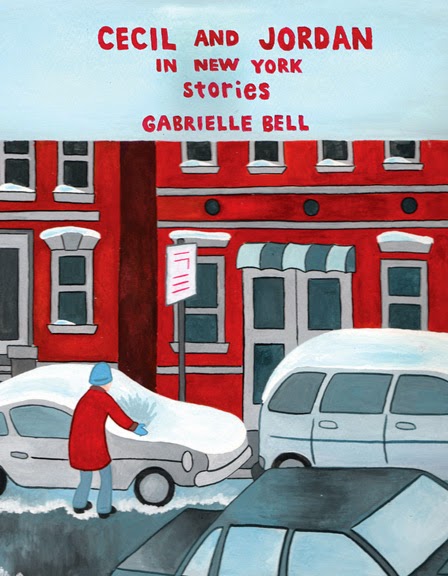
29/52: Cecil & Jordan in New York, by Gabrielle Bell
I've read a few of Bell's works recently. This one is a sequence of short stories about New York life and adventures. I think I prefer her more autobiographical works, and I guess I couldn't tell with many of the stories in this book whether or not they're personal stories. The drawings are great, and the story-telling is pretty good, but it didn't add up to a captivating reading experience, for me.

30/52: All & Sundry: Uncollected Work (2004-2009), by Paul Hornschemeier
More exploration of Hornschemeier's works. This one truly is all and sundry and collected and uncollected. I laughed out loud at many of these stories and drawings. I shed some tears at others. I scratched my head and beard with others. And some I just skimmed right through and couldn't cohesively consider. Certainly, highly recommended for the aspiring conoisseur of modern graphic novelism, but not at all for anyone else.

31/52: Mother Come Home, by Paul Hornschemeier
Oy, more Hornschemeier and more crying. How does he do it? This one was depressingly heart-wrenching but I couldn't put it down. I seriously remember sitting around reading some pages in this, slamming the book closed, tossing it on the ground, and saying out loud, "God damnit, man." And sighing loudly. And taking another sip of wine. And then another. And then picking up the book enthusiastically again. Because I just couldn't avoid reading more.

32/52: Uncharted: Big Data as a Lens on Human Culture, by Erez Aiden & Jean-Baptiste Michel
Really well-written. It's great to see some modern science/math/tech people who can appeal to broad audiences, tell good stories, and write in an engaging and intelligent way without sacrificing truth and rigor, ultimately. In particular, this book left me wondering about a lot of interesting questions and made me feel inspired to explore them and do some science. If you haven't explored it before, you need to play around with Google's NGram viewer. The authors of this book are its creators and they describe its genesis and uses extensively in this book. Highly recommended, to anyone.

33/52: The Voyeurs, by Gabrielle Bell
More Gabrielle Bell and, looking back, most likely my favorite collection of hers. These stories are more interesting and better told than those in her other books, I think. I particularly liked the diary-style aspect of this one, at least for part of it. If you're looking to explore her work, I'd start here.

34/52: Best American Comics: 2009, editors: Charles Burns, Jessica Abel, Matt Madden
Lots of good comics in here. Lots of weird shit, too. A smattering of so-so stuffing. I will happily explore more entries in this series, with the understanding that I'll likely get more of the same: a few things I'll love, a glut of things I'll find okay, and some stuff I'll flip through quickly. You should expect the same.
35/52: The Point: Stories, by Charles D'Ambrosio
I totally forget how D'Ambrosio entered my cultural consciousness, but here he is, fully formed. And I'm glad. These stories are … well, not outright depressing, but they make no pretense of being otherwise. I read through these one by one and required hours- to days-long reading breaks in between them. Dense and rich with emotional intensity, these are. I'll recommend if you're looking for something potentially engaging but also potentially overpowering. You've been goaded, and warned.

36/52: First Thought, Best Thought: The Art of Spontaneous & Inspired Writing Taught by Four Legendary Mentors of the Craft, by Allen Ginsberg, Anne Waldman, William S. Burroughs, Diane Di Prima
I've starting exploring audiobook titles through the OverDrive app. (Through your local library, you can log in and download various ebooks and audiobooks! It's very convenient.) This one is a recording of four lectures by some Beat-generation writers about their methods and history, for an audience at a writing school, over the years. Allen Ginsberg's lecture was about rhythm and meter in poetry and, despite my boring description, was actually quite fascinating. He's a dynamic speaker. William Burroughs spoke about his "cutting" technique of splicing together words from literal newspaper clippings and the like. It was inspiring, but I've yet to do anything about it. Diane DiPrima spoke about printing presses and properly distributing one's work. It was fine, but she came across as a bit of an unrelenting Luddite, although I think that was part of her point. I don't even remember who the fourth speaker was, alas, which says something about how interesting her lecture was. (Yes, I looked the name up to title this one, but otherwise couldn't remember.) Anyhow, consider checking this out if you fancy yourself a writer, or if you are a fan of Ginsberg/Burroughs/DiPrime/what's-her-name. Otherwise, don't bother.

37/52: The Perks of Being a Wallflower, by Stephen Chbosky
I picked this movie up from the public library a few weeks back, for whatever reason. The name jumped out at me from the DVD's spine as I scanned across the P section, and I remembered the hype around it being filmed in Pittsburgh a few years ago when I was there. So I watched it, having no real idea of what it was about, except for some sort of "coming of age" story. There's more to it than that. I ended up enjoying the film, for what it was, and decided I should read the novel, too. So I did. It was a quick read, only a day or two, including reading the entire second half in one sitting over dinner and a couple of drinks one evening. I still don't know think I know what to make of it, but I found it an enjoyable read. It's tough to entirely relate to any of the characters, but I'm not sure what that means. Maybe that's not the goal.

Other readings that kinda count:
The Lagoon, by Lili Carré:
A haunting graphic novel that I thoroughly enjoyed. This was a quick read, so I paired it with one of the above Hornschemeier books to "count" as a read.

Mr Wonderful, by Daniel Clowes:
A graphic short story I found and read entirely inside the library. The shape of the book and imagery on the cover caught my eye, so I took it to a table and ended up reading it in about half an hour. Enjoyable, and will look for more of Clowes' work in the future.

The Ideal Teacher, by George Hebert Palmer:
Recommended read from my mother. She has a physical copy of this book which she received as a gift from a former student of hers. It's a veritable relic, yet very little of the author's message is without meaning today. I found this to be a great essay from an educator about education, and it behooves modern educators to read it and reflect on just how much of the author's message still applies.

Kids Are Weird, by Jeffrey Brown:
A fun read that shows how … well, the minds of children will spew forth weird, seemingly random thoughts that make us smile, chuckle, and shake our heads. I can't wait to have kids so I can (a) mess with them, (b) teach them things, and mostly, as this book points out, (c) serve as a vessel/recorder for the truly crazy shit they will inevitably say/do.

The Wrong Place, by Brecht Evans:
Loved the watercolor aspects of this work. Every other graphic novel I've read stresses the ink lining, the comic-strip-style depiction of persons, the sharp contrast between image and text. This one blurs all of those lines and curves, and I loved it for that. The story, itself? Meh. But the format was superb.

Up next:
I will not fill in this section because, well, it's already May and telling you about books I was going to start reading in early April is pointless since I have, by now, already finished most of those anyway.
That said, I will be posting the April update of this series later tonight or tomorrow, so there's no need to worry. Not that you were, anyway. kthxbye

Monday, March 3, 2014

52 Books - February update: 21/52

A previous post of mine said that I will be reading 52 books in this year's 52 weeks. I fully intend to achieve that goal. Here is my progress:

As of last post, I had 10 books down and now, with the year's shortest month done and gone, I have 21 (!?!?!) completed! I've had to improvise some rules lately about what "counts" as "reading a book this year", as you'll see, but, ultimately, I'm trying to be generous towards encouraging myself to read more, which is the goal of the project anyway, right? So, even with some "lax" rules about counting books, I'm making significant progress towards the ultimate goal:

I finished a series of novels I started within the last post; they were fun, quick reads, and I even experienced some funny coincidences around them (and have plans to continue with more … books, that is). I finished a dense book I technically started before Jan 01, but I counted it (because of external explorations). I read a series of graphic novels and ended up counting some of them as fractions of a book (but I don't want this to be a comment on graphic novels, as a genre, only on my ability to read them at a brisk pace and their smaller page counts). And I'm looking forward to many of the books I'm diving into next …

Here's what I've managed to read since my last update:

11/52: Sunny Side Down, by Levni Yilmaz
This was a fun one. I've followed Lev's YouTube channel for a few years and have always enjoyed his quirky, self-deprecating humor, interesting voice, and "in the moment" drawing style. I spotted this book at the Harvard Book Store (not the Coop) a couple months ago for a dirt cheap price and had to buy it. It reads a bit like a collection of thoughts/stories/opinions and a bit like a graphic novel. It's laid out chronologically over Lev's life, from high school to college and to becoming an "adult" and then to "becoming" an adult. His humor shines through, and the drawings are simple yet lively. I think the organization doesn't do much to display his creativity, unfortunately. I found myself laughing out loud to some of it, smirking at other parts, yet just flipping through the rest. Meanwhile, his YouTube videos have me chuckling and smiling the whole way through. Perhaps this says more about my attention span than his comic stylings, but sobeit. I think Lev was hamstringed by the written format, and he did quite well with it. I will still recommend this to anyone who follows Tales of Mere Existence, especially, as well as anyone who just wants to laugh about some awkward times in their life (i.e. high school, dating, finding a job, dealing with parents, etc.)

12/52: Persepolis, by Marjane Satrapi
I can't recall exactly how I decided to read this book. I have a distinct memory of the film version being shown at CMU a few years ago, and a friend recommending it. But how did it reenter my consciousness recently? I have no idea. Perhaps it's because I've lately been stopping by the "graphic novels" section of the Boston Public Library every time I go there (I mean, it's right by the front desk) and this popped back into my brain, or perhaps … the author's name stuck in my head all these years and it spilled out of my mind. Whatever the reason, I found myself looking up this book and finding it upstairs in the "teen graphic novel" section. I almost awkwardly walked into the actual young adult section of the library before realizing the "graphic novel" section is on a shelf just outside. There was only a librarian inside‘an elderly-looking lady‘and then some kids who looked no more than 14. Then, I spotted the right shelf and found the book I sought. At that moment, a teenager at an adjacent table caught my attention to ask about my beard. He was sitting with a lady-friend, and he asked me how long I had been growing my beard. I said, "Since last summer", which was not entirely true, since I've trimmed a couple times since then, but I find it's the easiest way to phrase the true answer of "I've had a beard for like 8 years but the last time I trimmed down to almost nothing was last summer". He said he was trying to grow, as well, and stroked the 4 hairs protruding from his chin. I wished him luck and moved on.

Anyhow, this book was amazing. The stories are very well told, and the drawings are entertaining and engaging. I read this book over a handful of coffee shop excursions and, on several occasions, I found myself tearing up and wondering whether it would be appropriate to start sniffling and tear-shedding in public. How many books have made you debate that? I thought about how sheltered my life is, in comparison; I thought about how, even despite Satrapi's breadth of experiences, she still felt under-appreciative of her life, at times; I thought about the tragedies of war and the futility of it all; I thought about the universality of love, personality, and humanity. It was beautiful.

13/52: Ask The Dust, by John Fante
This was the 2nd stop on my Bandini excursion, having read The Road to Los Angeles last month. Typical Bandini here, and typical Fante, in a great way. He has a way with words, and I can see why (and how) Bukowski was influenced by his blunt yet evocative prose. I worry that the more removed society becomes from the culture of the 1930s and 1940s, the less interesting the love story in this novel will become, the less believable the characters will be, and so on. Regardless, this is a solid novel, and an enjoyable read.
What's more, I learned in the last few weeks that there is a film version of this novel. I have no pre-conception for how good of a film it is, let alone how accurate it might be. Turns out, the Boston library system had it, and I now hold the DVD in my hands. It stars Salma Hayek and Colin Farrell. I'm already kinda cringing. But I hope it's good … The novel was great, anyway!


14/52: Homer: The Odyssey & Chaucer: The Canterbury Tales & Dante's Divine Comedy, adapted by Seymour Chwast
I ended up counting all of these as one book because they were super quick reads. I finished each in about an hour or two. (I didn't read these in precisely this order, but it's easier to count them all as 1 book here.) Also, I'd already read The Odyssey and Dante's trilogy before, so that made it easier, I guess. Funnily enough, though, it was the Canterbury Tales adaptation that I liked the most! Chwast was faithful to the underlying stories (from what I remember/could tell) but played around with the graphics. The Odyssey was drawn as an intergalactic journey, played out via ancient Greek war. The journey in the Canterbury Tales occurred on motorcycles. And the narrating protagonist of Dante's trilogy was an Inspector Gadget-looking character, sans gadgets. I admired the ambition of these undertakings, and appreciated the appropriation of classic tales into a more modern (perhaps?) format, but I felt like much of this was just done to be said that it was done. Ya know? I'd recommend the Chaucer version to anyone, and the others only to those who either already know the story and want to experience a "different" telling, or those who don't know the story and want a more visual introduction.

15/52: The Mathematics of Games, by John D. Beasley
I took out this book to potentially find some interesting examples to play in math classes, but also out of interest, and to possibly find some interesting research projects for myself and for students. I ended up reading through it over a couple of weeks, and not getting any good examples for class, per se, but I did find some interesting potential for some Math Club activities or seminar talks/presentations, and research ideas. I was intrigued by some examples like the Sylver Coinage game, where a winning strategy for Player 1 can be proven to exist, and yet actually implementing that strategy is incredibly difficult, conceptually, as well as computationally time-consuming. I'd recommend this for folks who are already kinda mathy and want to learn more about how to analyze games, but anyone who has already studied game theory, in any sense, would just get turned off by the lack of rigor. Likewise, anyone who just likes games but is "not a math person" (as much as I hate that phrase), will be turned off by the lack of explanations. I enjoyed it, though!

16/52: Heads or Tails: Stories, by Lili Carré
These are fascinating, well-told yet sometimes abstract stories. Never mind the fact that the graphics are awesome. These stories are great. Set them into perfectly laid-out panels with eye-grabbing drawings that complement the stories perfectly … and you have a helluva book. I ended up reading through this pretty quickly in one evening out at a coffee shop, but I'm absolutely going to read through it again before I return it to the library. What's even more remarkable, to me, is that none of these stories feels like the centerpiece, nor the filler; they all contribute to the collection. And the graphics are distinct enough between stories that I'm amazed this was all done by one author/illustrator!

17/52: Funny Misshapen Body, by Jeffrey Brown
I picked this one up perusing the graphic novel section at the library. It looked like a longer story format than the other graphic novels I've read recently, so I was intrigued. It has a stark, black and white, panel-by-panel format, but Brown's broad and sketchy strokes really fill it all in and give it some energy. Also, it's an intensely personal telling of his childhood, teens and college years, and later development into a "professional" life. At times, I cringed. Other times, I laughed. Other times, I cringed about how I was laughing. Ultimately, I enjoyed the stories but the drawing left something to be desired. I felt like I had to be someone who already cared a lot about the graphic novel as a visual and story-telling art form to really appreciate this one. Not that I didn't. But I felt like it didn't speak to me as much as some other graphic novels have. Just some thoughts.

Coincidentally, from having this on my Goodreads list, I recently ended up winning a contest for an advance copy of Jeff Brown's new book, Kids Are Weird: And Other Observations from Parenthood! So I'm looking forward to getting that book and reading it! Check out a review next month or so.

18/52: Philosophy of Mathematics: A Contemporary Introduction to the World of Proofs and Pictures , by James Robert Brown
This is the book that I technically started a few days before this year. I remember cracking it open on the MegaBus ride from Boston down to NYC to visit my sister and her bf and some old friends, right after Christmas. This has been a dense read, and has prompted me to have so many "staring out the window and thinking" sessions; it has also pointed me, via the "suggested reading" sections, towards many articles and books that I've perused in the meantime. So I feel fine counting this as a book this year. I still have like 10 post-it notes stuck in the book, reminders of things to look up and read about.
This author is so blatantly and unapologetically Platonist that it almost made me put the book down, on several occasions. But despite that, I actually really liked it, for how broad of a survey it is of interesting topics it is, while simultaneously presenting those topics in sufficient depth to convey their intrigue and open problems/questions. I'd highly recommend this book to any mathematician curious about philosophy, and vice-versa, but I would warn either party about the heavy biases of the author. Take them with large spoonfuls of NaCl, and you'll be fine.

19/52: Dreams from Bunker Hill, by John Fante
Ah, the closing chapter (chronologically, anyway) of the Arturo Bandini saga. Interestingly, I ended up starting and finishing this entire book in an evening sitting at the Bukoswki Tavern in Cambridge. I've been to their location near the Hynes T stop a lot (I live near there) but had never been to the Cambridge spot. I found myself in Centra Square last Saturday afternoon and ended up going here for the evening. I spent a couple of hours sitting at the bar with some beers, finished this book, and went on my merry way! Good times. I felt that was appropriate, considering the influence on Buk himself.

20/52: Life With Mr. Dangerous, by Paul Hornschemeier
I heard about this author via the Comedy Bang Bang! podcast/TV show. I'm a regular listener (viewer whenever it's available online), so I recently learned that Paul is the guy who does the graphics for the TV show. I found this book at, you guessed it, the Boston library and dove right in. I ended up finishing it in one sitting at a coffee shop later that evening on Newbury Street. I laughed and frowned and sighed and smirked along with it all. This is really a novel in graphic form. This sounds patronizing, given the format, but it bears repeating. This book has great story-telling, compelling characters, and benefits even further from the author's ability to exploit the visual form. Just read this. It'll take you an hour or two. If you like it, awesome; go find more like it. If you don't, fine. I owe you a beer for two hours of your life "wasted".

21/52: The Stranger, by Albert Camus
This has been on my "to read" list for so many years. I'm pretty sure I obtained the paperback copy I have now from a used bookstore, but I can't even remember which one. Maybe it was a library sale? Maybe it was a Pittsburgh bookstore? There's no price penciled in anywhere. There's also a name written in ink on the inside cover, and copious highlighting and margin-notes throughout. So I don't know what to think. Except this: what a book!
Honestly, thank you to whoever Jamie Gilder is, or whoever borrowed this book from Jamie. I loved your highlighting and note-taking (for the most part). It really underscored my reading of this novel as an existentialist description of one man's life; and, ultimately, what else could we ask for, as fellow human beings?
I'm not sure why I'd put this one off for so long. Perhaps I'll dive into more French literature now. (Also, the version I have has a cover illustrated by Leo Lionni, who I know well for Swimmy!)

Up next:
Wait Until Spring, Bandini, by John Fante:
I read so many Fante novels recently that I couldn't resist more! Earlier today, I found this at the (yup, my fave place) Boston library, and started reading it at (yup) Bukowski's. This is the first novel in that Bandini saga, and I'd never read it before! So I have to. I'll be done by the weekend, I predict.

The Mathematical Magpie, edited by Clifton Fadiman:
I started this last month, and described an earlier compilation by the same editor with similar ambitions, Fantasia Mathematica. I'm about 2/3 through this one, and should be finished soon.

Gravity's Rainbow, by Thomas Pynchon:
Yeah yeah yeah, I keep saying it. But this is it. March is the month I fucking tackle this book.

Wise Blood, by Flannery O'Connor:
I saw the film version of this a few years ago, when I was in a "Criterion Collection" phase. (Who am I kidding? I'm still in that phase, it's just less frequently acted-upon.) And then, last weekend, I went to a local concert and saw an artist called Weyes Blood and she reminded me of this. (By the by, her set was amazing. Wonderful singer. Check out her Bandcamp page here.) I found myself in the fiction section at the library today and thought, "Aha, O'Connor!" Here we go.

I have a few other graphic novels in the mix, too. I've been on somewhat of a kick with them recently. Mostly, I think this is because they're "quick reads", and I can easily fit them in between grading and class prep and, ya know, sleep and whatnot. So, my reading list feels unfairly padded this month, and my pace will likely slow over the next few months. Spring break is next week (w00t!) but I'd also like to be more ambitious about reading material (and length) over the next couple of months, so it'll all balance out, I think.

Ultimately, I think the whole project is working out, in the sense that (a) not only am I choosing to spend my free time outside of class/work in reading mode, but (b) I'm actively making time for these adventures. I'm going to the library a lot, both on campus and in Copley, to find new books and explore the shelves. Whenever I have some free time, I crack open a book. At very few times, I do feel like I'm reading so that I can get through some books I'm working on; but, then again, I realize I'm only doing this so I can get ahead and read some more books that I'll love even more. Huzzah!


Until next time! Keep on readin' on, my friends.