Showing posts with label writing. Show all posts

Sunday, June 22, 2014

A Proposal of Modest Proportions: that time I wrote an essay in high school in the style of Jonathan Swift

I was talking to my cousin Will the other day and he mentioned that he took a course on humor in literature. I mentioned Jonathan Swift, known for his classic satirical piece A Modest Proposal, wherein "Swift suggests that the impoverished Irish might ease their economic troubles by selling their children as food for rich gentlemen and ladies." (source) And I then recalled having not only read that essay in my English class in high school, but also having written a satire on that satire!

I do not remember the details of the assignment, or how I came to this idea, but I wrote an essay that both satirized and paid homage to Swift's writing style, while simultaneously putting forth several "suggestions" about how to improve the game of golf into a sport. As an avid golfer, this was all written with my tongue poking right out through my cheek. I enjoyed writing this very much and was ecstatic to later win an essay prize for it!

Here it is in its unedited entirety:

-----------------------------------
Brendan Sullivan
AP English Literature
May 3, 2003

A Proposal of Modest Proportions:

How to Make Golf a Real Sport


When one examines the physical and intellectual capabilities required of participants in many of today’s popular sports, one might observe that these characteristics encourage athletes to train and prepare to become both mentally and physically fit. For example, the sport of long-distance running, particularly the marathon, breeds contestants who are not only able-bodied, muscular, and healthy, but also mentally sound, for there is indeed an intense cerebral component to this sport. To complete the same motion, that is placing one foot in front of the other, for approximately 26 miles, occurring over a time period of anywhere from two to twelve hours, depending on the ability of the performer, is a mentally demanding task, and one that should not be taken lightly. Now, if one studies the professional sports that are popular with today’s television-viewing public, such as baseball, football, or wrestling, it is clear that a similar level of physical and mental aptitude is required of the players, who are sufficiently rewarded for their services, as seen in their moderately respectable salaries.

There is one sport, however, which has received some not undeserved criticism for its players’ lack of function of mind and body: golf. A majority of sports enthusiasts and aficionados have criticized this sport (the term “sport” being used loosely in this sense, as its status as such being similarly questioned) for producing overweight, weak, and I might add, simple-minded, players, who have apparently been relegated to the unfortunate rank of “professional golfer” due to their incompetence in other, more demanding and respectable, athletic endeavors. One must only look at past and present golfers, such as Craig Stadler, aptly nicknamed “The Walrus” for his tremendous girth, both in waist and in mustache, to be convinced that this game produces individuals who are extremely thick (to be interpreted in both senses). Even Jack Nicklaus, the game’s “greatest player,” at least in the twentieth century, was widely known for his practically pear-shaped torso, culminating at the brain in an almost metaphorically nonexistent stem.

Lest one has forgotten, as well, or in the same manner, due to proper ignorance of this game, has never learned of the various incidents of stupidity exhibited by professional golfers, I shall convey these stories. Most widely known among the measly 26.5 million golfers in this country is the story of Roberto de Vicenzo, who, in 1968, surrendered a place in a playoff for the title at the Masters Tournament after authorizing with his signature an incorrectly tallied scorecard kept by his playing partner, Tommy Aaron, who had marked de Vicenzo’s score for the 17th hole as a 4 instead of a 3. Surely, if these poor souls cannot even count to four, how can we expect them to serve as role models for our nation’s youth, a responsibility that, thankfully, has been adopted by the much nobler, law-abiding athletes of professional basketball and football.

Slightly lesser known, yet still a prime example of the very mental incompetence of which I speak, is the story of the aforementioned Craig Stadler incurring a two-stroke penalty for not comprehending one of the basic rules of the game. In a tournament in 1987, Stadler was forced to play a shot while kneeling, due to some low-hanging tree branches above his ball that prevented him from taking a normal swing. To preserve the untarnished condition of his trousers, Stadler placed a towel on the ground, which prompted a television-viewer at home to telephone the tournament officials and correctly inform them that Stadler had violated Rule 17-1, which unequivocally states that “a player shall not improve . . .the area of his intended swing.” Again, this is a strong deterrent from allowing our children to watch these golf events, as these players hardly even know their rules better than the average Joe sitting on his living room couch.

I would be rightfully described as disrespectful and negligent if I were to merely identify this already-recognized situation. To prevent this criticism, I shall therefore propose a variety of schemes that will not only make the game more demanding, both physically and mentally, but also much more interesting to watch for the general public. These suggestions will attempt to incorporate the admirable characteristics of other professional sports into the game of golf, in an effort to make the game more like a true sport.

Firstly, the use of caddies, a tradition that undoubtedly developed from the game’s origins in 17th century Scotland when some foolish golfer probably indulged himself in an excessive amount of Scotch and consequently lost his ability to even carry his own bag, will be abolished. Since baseball players are forced to carry their bats from the dugout to the batter’s box, shouldn’t golfers be similarly required to carry their “bats?” In addition, the prohibition of caddies will compel the players to cogitate without external assistance, an aid that the players have come to rely on too heavily, as they can hardly even take a drink of water without asking their pathetic subordinate for help, thus necessitating a keen intellect.

Secondly, there has been much discussion today about the lengthening of golf courses, particularly to “Tiger-proof” them and prevent this dominant golfer, Tiger Woods, who for some reason was featured as the “Sportsman of the Year” in Sports Illustrated in 1996 and 2000 (evidently, the magazine editors were bribed or blackmailed into awarding such a prestigious title to an undeserving golfer). Not only is Tiger prompting this craze for distance, but the improving technology, as well, has yielded this onslaught of opinion in favor of increased yardage. It seems as though every day there is a new club, ball, glove, tee, shoe, or some other fancy contraption, that promises increased distance and accuracy. “Twenty yards longer, and thirty percent straighter” is an example of a claim that might be made by a golf equipment company. These assertions are partially true, as professional golfers are continually hitting their brand-new, high-tech, updated balls ever farther down the fairway and ever closer to the hole with their brand-new, high-tech, updated clubs.

This begs the question, how do other sports respond to such drastic improvements in technique, bordering on the edge of unfairness? In baseball, for example, officials have become more aware of corked bats and seek to prevent cheaters from hitting pitch after pitch out of the ballpark. Similarly, the Professional Golf Association should impose stricter limits on players’ equipment, thus putting an end to the current trend towards limitless distance and clubheads larger than one’s foot with spring-like properties at impact almost on the order of magnitude of particle accelerators. I humbly suggest that first of all, the current limit of 14 clubs should be reduced to a more reasonable number, such as two or three, in respect to equity, for basketball players are allowed but one ball on the court at a time. In addition, I feel that these two or three clubs should be restricted to a material such as wood or paper, which would serve to reduce the explosive power of the modern-day titanium, steel, or other metallic alloys that are being fashioned into drivers.

Now, particularly clever and studious patrons of baseball history might argue that Major League Baseball did not respond to such displays of power as Roger Maris’ 61 home runs in 1961 by greatly lengthening the distance between home plate and the outfield wall, or by moving the pitcher’s mound closer to home plate. In fact, this is exactly why I propose to lengthen golf courses by a significant amount; it would be unprecedented, a trend-setter, a paragon for other sports to follow. What could golfers possibly enjoy more than returning home from an 18 hole round on their local, 20,000 yard, par 54, public course and lounging in front of their big-screen television, on their oversize couch, with a two-gallon soda in one hand and a three-pound bag of potato chips in the other, to watch a football game played on a 250-yard field, or to see a batter hit a 500-foot pop fly that only reaches halfway to the bleachers, or to see another airball shot from behind the 60-foot three-point line, all because these sports decided to follow the example set by the PGA? Now that would be entertainment!

Thirdly, continuing on the theme of making golf more difficult, and subsequently more entertaining, I suggest that the so-called “hazards” should be more hazardous. One major aspect of sports in the modern age is injuries: broken wrists resulting from diving for a line drive, concussions from being tackled by a charging lineman, and skin lacerations from being scratched by an opponent’s eyebrow ring while battling for a rebound—all of these potential mishaps add to the excitement of sport. Where, I ask, is there a risk for injury in golf? Excluding the inconsequential heat strokes, pulling of muscles, food poisoning (which Tiger Woods himself suffered from after carelessly consuming his girlfriend’s poorly-cooked spaghetti), and the countless kinds of back injuries that result from years of twisting one’s body back and forth hundreds of times a day, there exists no major disease, affliction, or condition that could possibly plague a golfer any more than the average human, and therefore the excitement is lessened.

To remedy this, bunkers, or sand traps, should be replaced with quicksand traps. Not only would this force players to be more accurate with their approach shots in an effort to avoid these hazards, but they would also force the golfer to hit the shot hastily. Due to the ever-present risk of becoming an eternal part of the hazard itself, any relatively sane golfer (my apologies for the blatant oxymoron) would be sure to spend a little less time settling his or her stance and taking a few practice swings, thereby shortening the abnormally and painfully long time period exhausted by a single round of golf.

Similarly, water hazards should be augmented, not only in size, but also in content. From now on, lakes, streams, creeks, burns, and ponds shall contain all varieties of poisonous insect, frog, fish, amphibian, and reptile, namely piranhas, alligators, poison-dart frogs, and an assortment of species of deadly flies and bees. Likewise, forests adjoining golf holes should be inhabited by all sorts of creatures, such as grizzly bears, wolves, coyotes, and if possible, depending on the course’s location, savage cannibal warriors. These new and improved hazards would also quicken the pace of play while boosting the excitement factor at the same time, for who wouldn’t enjoy watching a frantic golfer sprint down the fairway with a menacing grizzly in hot pursuit and narrowly escape the bear to finish the hole in a record-breaking 6.2 seconds?

While I am considering the topic of time commitment, I shall introduce my next modest suggestion, which is the concept of a timed element of play in this getting-close-to-a-sport-now game of golf. Consider, for a brief moment, the impact of a clock on the outcome of football or basketball. Not only is there a game clock, there is also a shot clock or play clock. Each time-out is carefully timed by the referees. There are two-minute warnings, loud buzzers, and fans chanting the countdown from ten to zero. In fact, these sports enjoy the period-ending alerts so much that they play games in quarters, to allow this electrifying event to happen on four separate occasions throughout the game.

To allow for similar excitement to be instilled in the somewhat humdrum and tedious affairs of golf, I suggest that a game clock be utilized during a golf tournament. At the beginning of the tournament the clock should be set for ninety minutes, and upon commencement of the round, when all players tee off simultaneously on the first hole, the clock will count down. Any player who does not complete his or her eighteen hole round in the allotted time period, which is an entirely reasonable amount of time, will be immediately disqualified.

A correlated consequence of this decree would be the subsequent universal adoption of a new style of play. Golfers will no longer leisurely promenade between shots while idly gazing at their surroundings, signing autographs for fans, or pondering their next shot. Instead, players will hurriedly dash to their ball’s location and, within a matter of seconds, hit the ball, only to dash off once again. This would assist in enhancing the mental and physical properties of all players involved, a process which, as I have previously mentioned, has been lacking for quite some time. The exercise required for the actual running on these lengthened, hazard-filled courses, would surely improve the kinesthetic functioning of all players, and the required quick thinking and decision-making would make golfers slightly more intelligent, although certainly not up to par (no pun intended) by normal standards. All in all, the introduction of a game clock could do no wrong in bringing the game of golf out of its confines, and might possibly change it from a “good walk spoiled” (in the words of Mark Twain) to a good run spoiled.

While professional golfers are rushing from shot to shot, desperately trying to avoid each hazard on their quest to beat the clock as well as par, I believe that the players should encounter another obstacle: defense. Surely, this could not continue unobserved for too long. Baseball, basketball, football—all these sports present two teams on opposing sides of the field, with both trying to score and attempting to prevent the other team from scoring. Why is there no element of defense in golf? Besides the incredibly difficult courses, carefully designed and carved out of the landscape to present golfers with every imaginable obstacle, along with the forces of nature, such as wind, rain, and heat, there is no resistance offered by an opposing side.

To fill this unfavorable gap in the game’s properties, I recommend that each competing golfer be allowed to hit not only his or her own ball, but also the ball of an opponent and, in doing so, place that adversary in a less manageable situation, such as in one of the new and improved quicksand traps. Such an act would incur no penalty on the player and would in fact be encouraged, as it would make the game more difficult, both by forcing players to incorporate new strategic measures and by intensifying the battle against the game clock, for hunting for a ball recently batted away by an opponent would waste precious seconds.

Finally, my last proposal to make the game of golf more exciting for the spectators, and more exhausting and demanding for the players, is to modify the concept of “sudden death.” When a golf tournament remains tied after regulation play, it is customary at some tournaments to complete a sudden death playoff, where the first player to beat his or her opponent on an extra hole is regarded as the winner. I advocate a new playoff system, one that would involve literal sudden death. Each player involved in the playoff should be given an opportunity to hit their shots, after which the player furthest from the hole would be subsequently shot for the poor quality of their shot. This process would continue until only one player remains, who would therefore be declared the champion. Obviously, if only two players are competing in the playoff, this procedure should not take too much time or effort on the part of the tournament committee, and the matter should be resolved rather quickly, after the first shot.

It goes without saying, which is why I am saying it, that these new rules and systems should only be adopted by the professional golfers, and not by amateurs. In other sports, amateurs and professionals play different games by different rules. For example, how many pickup basketball games provide three referees, an array of sportscasters, and cheerleaders and slam-dunking mascots at halftime? Accordingly, every effort should be made to ensure that the game played by amateur golfers remain at its current state. The aforesaid proposals are only intended to improve the quality of the game for the entertainment of the television-viewing public and, at the same time, counter the countless complaints of these obese, unintelligent wannabe athletes polluting the nation’s professional sports arena. In no way am I suggesting that something be done about the obese, unintelligent wannabe athletes polluting the nation’s amateur sports arena. That topic alone, my dear reader, would warrant its own modest proposal.

Friday, May 2, 2014

a story I wrote in 2006 about the first time I played The Old Course in St Andrews

I recently had the need to look for something on my external hard drive. During that process, I stumbled on a folder of old writings I did back in college. Naturally, I read through a lot of them. My reactions varied: I shook my head in shame, I laughed out loud at stupid memories, I chuckled at the combination of my naivete and insight, and I smirked whenever I found something that was actually interesting and readable. I hope that the ensuing short (quite short, indeed) story falls into the latter category, for you.


“My first tee shot on the Old Course”

The starter announced over his loudspeaker, “7:10 game, play away.” I yawned and looked out to the beach, just a few hundred yards away. The sun was just peeking over the horizon, reluctantly sprouting upwards from the glistening water. It had been light out for only two hours. I had been up for one and a half.

“That’s us! Yahoo!” chirped Darrell, a squat, brutish man who I had met only five minutes before. He slapped me on the back mid-yawn, rocketing me into a spasming hiccough. Our playing partner, Daniel, walked by as I half-choked, smiling brightly for absolutely no reason. I didn’t see him frown all day. It frightened me.

I was supposed to be excited. This was St Andrews, the home, the cradle, the birthplace of golf—where it all began! And here I was about to tee off. I should have been brimming with anticipation. I should have been nervous. I should have been shaking. I was only tired.

That was while I was waiting. Darrell started us off, whipping out an extra long wooden tee, painted green. “Luck o’ the Irish, eh?” he laughed, before shoving the tee into the dewy grass. “Ahhhhh, let’s see.” He waggled his oversized driver. “Let’s see if I can’t spank this down the short grass.” I couldn’t help thinking whether he was compensating for something, even though it was a clichéd phrase, and I hate clichés.

His swing was jerky, nowhere near as smooth as his drawl, but every bit as jolting. I almost fell over during his backswing. It was so quick and spasmodic that even though I was nearly thirty feet away, I was afraid the club might slip out of his hands and smack me square across the forehead before I had time to duck. The result was impressively beautiful for such an ugly motion—roughly 250 yards down the right side of the fairway. That’s what always intrigued me about golf: artfulness was never truly rewarded. “Hee hee! And they’re off!”

Daniel was next. He told us loudly he was from Switzerland. This was his first visit to Scotland. He was very excited. His swing was slightly more graceful than Darrell’s, and a hell of a lot more rhythmic. He posed for a few seconds at the conclusion of his swing, watching the ball trace a mesmerizing arc across the morning sky. The ball bounced in the middle of the fairway, 260 yards out, and he leaned down to pluck his tee from the ground. He bounced back up and smiled at me like a happy child. “Your turn!”

I suppressed a yawn. For some reason, now the nerves set in. I cursed the fact that I had stayed up until 1:30 am chatting on the internet. The five hour time difference with the US was ruining my daily schedule. I had selected a three-wood. The Swilkan burn crossed the fairway at roughly 300 yards. A driver could reach that with a healthy bounce if I really connected with it.

After shoving my tee into the ground and balancing my fresh Titleist on top, I glanced back at the clubhouse clock: 7:12 am. Seagulls screeched on the dunes. Grown men leaned on the fence of the practice putting green, watching. A single car passed by on the neighboring road. I saw my breath in the early chill. The fingers of my left hand clutched the grip while my right hand stretched outwards and upwards, lifting the sleeve of my collared shirt more comfortably onto my shoulder.

I approached the shining white ball in the center of the tee box, aligned my clubface and stared down the fairway. I could see the group ahead just teeing off on the second hole. A man on a riding mower cut the grass of the 17th green in the distance. The car that had passed by pulled into the parking lot of the hotel just beyond the 17th fairway. It was still 7:12 am.

I remember making contact. I remember watching the ball rise, peak and descend. I smiled and plucked my tee from the ground. My shoes slipped on the wet grass. Darrell gave me a high five and Daniel smiled. “Let us go play some golf, my friend!”

52 Books - March update (belated, obvi): 37/52

A previous post of mine said that I will be reading 52 books in this year's 52 weeks. I fully intend to achieve that goal. Here is my progress:

As of last post, I had 21 books down and felt like (a) I was ahead of pace yet (b) I wouldn't be able to keep it up. Here we are, well into April and I am even further ahead of schedule and show no signs of slowing. The first and second derivatives of Reading(x) appear to be positive!

In March, I did the following:
  • I read some collections of short stories, one by an author I know and love and others by totally new (to me) authors.
  • I explored the bibliographies of several graphic novelists I've come to admire, including Paul Hornschemeier, Gabrielle Bell, and Jason.
  • I read (and am reading) a few non-fiction books, especially about areas outside of mathematics.
  • I watched a film and then went back to read the novel on which it was based.
  • I wrote an essay for a forthcoming zine about Pittsburgh, and this reawakened a desire for writing in my own life. To wit …
  • I brainstormed some ideas for math books that I want to write, if I ever have the time.
  • I thought a lot about education and have some ideas for essays I want to write but no idea where to share them.
  • Most of all, I filled any spare moments I had between teaching, planning classes, grading, and walking/sleeping/eating/cooking by just sitting in my recliner with a soothing record on the player and propping open a book. If the rain was pattering, I'd keep the door open for a soundtrack. And I'd read.
Perhaps I've let my reading time start to bleed through and stain other activities in my life. But I feel like it's coloring them not with dirty, regrettable, red splotches; rather, it's filling my days with throbbing, exuberant, pulsating moments that can't help but spill over into every thought I have, every moment of my existence. I know this sounds crazy. That's why I love it and can't stop myself from typing this sentence. Okay, there. I stopped.
Here's what I've managed to ingest since my last update::

22/52: Don't Kiss Me: Stories, by Lindsay Hunter
Here's the review of this book I wrote on Goodreads:
I have to be in a certain mood to read Lindsay Hunter's stories, and I have to know ahead of time that they'll leave me in a certain mood afterwards. I still don't know what these stories "mean", but that's decidedly not the point with her prose. The process of reading, of twisting her words through my mouth and my brain, is the entire joy.
Yup, that's right. Try reading one of Lindsay's stories. You'll experience one of the following emotion/reaction combinations: "This is incredibly weird! I want to read more!"; "This is incredibly weird! What the fuck is this? I'll come back to this later."; "This is incredibly weird! I can't read any more of this."; "Qu'est-ce que c'est ici? C'est si bizarre!" Personally, I read each one and then put the book down on my lap and say, "What the fuck was that?" And then I chuckle out loud, and then I pick the book up again and read another story. That's just how our relationship is, and it's how I want it to be.

23/52: The Squirrel Mother: Stories, by Megan Kelso
This was mediocre, at best. Looking back, a few weeks removed, I recall a great story about Benjamin Franklin (I think?) and a terribly-told story about being left home alone by an aunt suffering from depression. There might have been another story about democracy and voting … maybe not. But this one just doesn't stick out. I was intrigued by the visuals of this book: seeing the cover and skimming through it at least made me check it out from the library, but after that … I checked out. Not boring, not offensive, not poor writing. Just all-around plain.

24/52: Wait Until Spring, Bandini, by John Fante
The final part of the Bandini series that I read over the last few months. This was the part I don't own a copy of, and I only found it in the library (and subsequently decided to read it) because I was already nearby in the fiction section. Strangely, I'm both upset and happy that this is one of the last Bandini saga entries I've ever read. This lends many insights into the Arturo Bandini character, of course, since this is the story of his upbringing. But I also kinda loved knowing Bandini as he was, not knowing where he came from, trying to reconstruct a past that would lead to his life; I thought of his parents and siblings and hometown through his own eyes and mind and narration. And now, well, I kinda still think that way, but I have his own personal narration to add to that. And it's great but also redundant. Yes, I'm talking as if I know this guy. Bye.

25/52: Beg The Question, by Bob Fingerman
I picked this one up from the library based on the cover and skimming through some pages. It looked like it would be funny and enjoyable and not a "flimsy read", so to speak. I wasn't wrong. Mostly, I enjoyed the characters in this story. They were well-developed, both personality-wise and artistically (in the graphics sense), and their interactions led to many funny and poignant situations. I couldn't really relate to them historically or situationally, so this novel only succeeded partially, in terms of those goals. But that wasn't the point, right? I enjoyed the read well enough.

26/52: An Invisible Thread, by Laura Schroff
I borrowed this book from my mom because she recommended I read it. So I did. Who am I to disobey? It was, indeed, a heart-warming tale of unlikely friendship, charity, perseverance, personality, and urban history. But it felt un-representative of the true story. It was half of the story, really. It entirely lacked the viewpoint of the male protagonist, whose name I've even forgotten by now, eve though he's the whole point of the story and the book, and even though I still somehow know that the writer's name is Laurie Schroff and she worked in advertising at USA Today when it was a big deal to get businesses to advertise in that paper and … ugh, I'm actually liking this book less and less the more I think about it. Too much of a mass-market fiction style to appeal to me, but, what's even worse, it tried so hard to be in that style.

27/52: Wise Blood, by Flannery O'Connor
I watched the film adaptation of this book a few years ago and enjoyed it. It was a well-made film and stands on its own. But I'm quite glad I read the novel, too. I don't intend this to contribute to the "Oh man, the book is always way better"-style debate. Rather, I'm pointing out that I'm glad I experienced both. They each have their merits. The cinematography of the film was so stark and gritty and sharp that, as I read the novel, still scenes from the film shot into my head. Facial expressions of the main characters stuck in my mind as I read about them. Meanwhile, a whole universe of interaction opened up as I read the narration and explored the characters in more depth than the visuals and dialogue could possibly convey. Between these two, I feel more experienced about this world that O'Connor established. I have no desire to live in that world. At all. But it was fascinating to enter for a few days.

28/52: The Mathematical Magpie, editor: Clifton Fadiman
More mathematical stories, essays, excerpts, poems, and short writings. Also collected and edited by Clifton Fadiman, in addition to Fantasia Mathematica, which I read a few months ago. This book is chock full of fun math stuff, and I have sticky notes fanning out from many of its pages. I'd love to see this kind of series continued for a more contemporary audience.

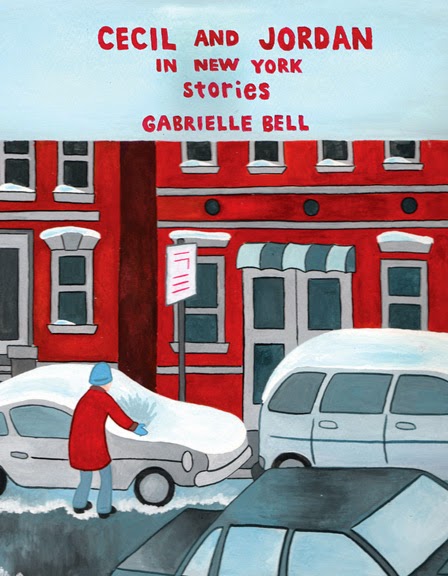
29/52: Cecil & Jordan in New York, by Gabrielle Bell
I've read a few of Bell's works recently. This one is a sequence of short stories about New York life and adventures. I think I prefer her more autobiographical works, and I guess I couldn't tell with many of the stories in this book whether or not they're personal stories. The drawings are great, and the story-telling is pretty good, but it didn't add up to a captivating reading experience, for me.

30/52: All & Sundry: Uncollected Work (2004-2009), by Paul Hornschemeier
More exploration of Hornschemeier's works. This one truly is all and sundry and collected and uncollected. I laughed out loud at many of these stories and drawings. I shed some tears at others. I scratched my head and beard with others. And some I just skimmed right through and couldn't cohesively consider. Certainly, highly recommended for the aspiring conoisseur of modern graphic novelism, but not at all for anyone else.

31/52: Mother Come Home, by Paul Hornschemeier
Oy, more Hornschemeier and more crying. How does he do it? This one was depressingly heart-wrenching but I couldn't put it down. I seriously remember sitting around reading some pages in this, slamming the book closed, tossing it on the ground, and saying out loud, "God damnit, man." And sighing loudly. And taking another sip of wine. And then another. And then picking up the book enthusiastically again. Because I just couldn't avoid reading more.

32/52: Uncharted: Big Data as a Lens on Human Culture, by Erez Aiden & Jean-Baptiste Michel
Really well-written. It's great to see some modern science/math/tech people who can appeal to broad audiences, tell good stories, and write in an engaging and intelligent way without sacrificing truth and rigor, ultimately. In particular, this book left me wondering about a lot of interesting questions and made me feel inspired to explore them and do some science. If you haven't explored it before, you need to play around with Google's NGram viewer. The authors of this book are its creators and they describe its genesis and uses extensively in this book. Highly recommended, to anyone.

33/52: The Voyeurs, by Gabrielle Bell
More Gabrielle Bell and, looking back, most likely my favorite collection of hers. These stories are more interesting and better told than those in her other books, I think. I particularly liked the diary-style aspect of this one, at least for part of it. If you're looking to explore her work, I'd start here.

34/52: Best American Comics: 2009, editors: Charles Burns, Jessica Abel, Matt Madden
Lots of good comics in here. Lots of weird shit, too. A smattering of so-so stuffing. I will happily explore more entries in this series, with the understanding that I'll likely get more of the same: a few things I'll love, a glut of things I'll find okay, and some stuff I'll flip through quickly. You should expect the same.

35/52: The Point: Stories, by Charles D'Ambrosio
I totally forget how D'Ambrosio entered my cultural consciousness, but here he is, fully formed. And I'm glad. These stories are … well, not outright depressing, but they make no pretense of being otherwise. I read through these one by one and required hours- to days-long reading breaks in between them. Dense and rich with emotional intensity, these are. I'll recommend if you're looking for something potentially engaging but also potentially overpowering. You've been goaded, and warned.

36/52: First Thought, Best Thought: The Art of Spontaneous & Inspired Writing Taught by Four Legendary Mentors of the Craft, by Allen Ginsberg, Anne Waldman, William S. Burroughs, Diane Di Prima
I've starting exploring audiobook titles through the OverDrive app. (Through your local library, you can log in and download various ebooks and audiobooks! It's very convenient.) This one is a recording of four lectures by some Beat-generation writers about their methods and history, for an audience at a writing school, over the years. Allen Ginsberg's lecture was about rhythm and meter in poetry and, despite my boring description, was actually quite fascinating. He's a dynamic speaker. William Burroughs spoke about his "cutting" technique of splicing together words from literal newspaper clippings and the like. It was inspiring, but I've yet to do anything about it. Diane DiPrima spoke about printing presses and properly distributing one's work. It was fine, but she came across as a bit of an unrelenting Luddite, although I think that was part of her point. I don't even remember who the fourth speaker was, alas, which says something about how interesting her lecture was. (Yes, I looked the name up to title this one, but otherwise couldn't remember.) Anyhow, consider checking this out if you fancy yourself a writer, or if you are a fan of Ginsberg/Burroughs/DiPrime/what's-her-name. Otherwise, don't bother.

37/52: The Perks of Being a Wallflower, by Stephen Chbosky
I picked this movie up from the public library a few weeks back, for whatever reason. The name jumped out at me from the DVD's spine as I scanned across the P section, and I remembered the hype around it being filmed in Pittsburgh a few years ago when I was there. So I watched it, having no real idea of what it was about, except for some sort of "coming of age" story. There's more to it than that. I ended up enjoying the film, for what it was, and decided I should read the novel, too. So I did. It was a quick read, only a day or two, including reading the entire second half in one sitting over dinner and a couple of drinks one evening. I still don't know think I know what to make of it, but I found it an enjoyable read. It's tough to entirely relate to any of the characters, but I'm not sure what that means. Maybe that's not the goal.

Other readings that kinda count:
The Lagoon, by Lili Carré:
A haunting graphic novel that I thoroughly enjoyed. This was a quick read, so I paired it with one of the above Hornschemeier books to "count" as a read.

Mr Wonderful, by Daniel Clowes:
A graphic short story I found and read entirely inside the library. The shape of the book and imagery on the cover caught my eye, so I took it to a table and ended up reading it in about half an hour. Enjoyable, and will look for more of Clowes' work in the future.

The Ideal Teacher, by George Hebert Palmer:
Recommended read from my mother. She has a physical copy of this book which she received as a gift from a former student of hers. It's a veritable relic, yet very little of the author's message is without meaning today. I found this to be a great essay from an educator about education, and it behooves modern educators to read it and reflect on just how much of the author's message still applies.

Kids Are Weird, by Jeffrey Brown:
A fun read that shows how … well, the minds of children will spew forth weird, seemingly random thoughts that make us smile, chuckle, and shake our heads. I can't wait to have kids so I can (a) mess with them, (b) teach them things, and mostly, as this book points out, (c) serve as a vessel/recorder for the truly crazy shit they will inevitably say/do.

The Wrong Place, by Brecht Evans:
Loved the watercolor aspects of this work. Every other graphic novel I've read stresses the ink lining, the comic-strip-style depiction of persons, the sharp contrast between image and text. This one blurs all of those lines and curves, and I loved it for that. The story, itself? Meh. But the format was superb.

Up next:
I will not fill in this section because, well, it's already May and telling you about books I was going to start reading in early April is pointless since I have, by now, already finished most of those anyway.
That said, I will be posting the April update of this series later tonight or tomorrow, so there's no need to worry. Not that you were, anyway. kthxbye

Friday, February 3, 2012

Concert Review: Jeffrey Foucault + Big Snow Big Thaw @ Club Cafe / 01.13.2012

Just catching up on some shows I've seen this year. I used to do these things for every concert I went to, and it served as a nice list of shows/bands I saw, at the very least, in addition to a record of my thoughts about them. I'm gonna try to keep up with that this year without falling behind too much (and some better reviews appear on Draw Us Lines when I have more thoughts to share and care more about my writing style).


I try to catch Big Snow Big Thaw at every chance, not just because they're my friends, but because they're great. I remembering being initially surprised at how much I dug these kinds of folksy/bluegrassy sounds, but then I realized that's just me being picky and closed-minded about musical tastes. Call it what you want—newgrass, folk rock, midwest rock 'n roll, somethin' else made up—it doesn't matter. It rocks. And every time they play, they've got new songs to share. They've been hard at work at J Bird Studios and their first album should be out real soon. (In the meantime, do yourself a favor and check out their Winter/Spring EP combo on Bandcamp.) That very same J, he of J Bird, played bass on a bunch of their songs, too, since he has been adding some bass parts during the recording. It rounded out the sound a little bit, and was a nice addition. Here's hoping they explore that route in the future. I caught their set at the Carnegie Library's Sunday afternoon acoustic series (photo above) a few days before this show, too, and that was great to see lots of strangers walking through and sit down and enjoy their tunes.


Jeffrey Foucault was an oustanding performer! Jim and David kinda warned me and the rest of the audience, saying that his soundcheck performance was amazing (he just walked up, no prep, and that voice belted out like he was born singing) and he strikes quite a presence with that magnificently thick beard. He was swigging something from a steel cup, and had been on the road all day, this being the first stop on his tour a long way from his previous night's activity of watching The Muppets with his daughter (why I remember that anecdote, I couldn't tell ya). I hadn't heard any of his songs before and yet I found myself mesmerized. The crowd skewed a little older, I think, and there were some seriously chatty drunkies in the back by the bar, but other than that, everyone was pretty much rapt as JF strummed and sang in front of those Club Café starlights. He did a great Neil Young cover (forget which song) but this number really stood out and was stuck in my head:


Apparently, you can join this Facebook group if you think Jeffrey Foucault isn't famous enough.

Jeffrey Foucault on the web: Website

Big Snow Big Thaw on the web: Facebook / Twitter / Bandcamp

Saturday, April 2, 2011

Jam of the day: "The Stand"

Artist: Mother Mother
Album: Eureka
Song: "The Stand"
Released: March 15, 2011
Label: Last Gang

I read about music a lot. I don't really know, but I wouldn't be too surprised to learn that a lot of great novelists don't really read a lot of contemporary fiction, or that great directors don't watch many films, and so on. But as a music blogger myself, I find myself constantly reading other music criticism: reviews, recommendations, interviews with bands, and so on. Logistically, there's a lot of music out there to be discovered and reading lots of other blogs helps me find new artists I like and see what others are listening to. Artistically, though, I generally like to know what others are up to, how they structure their websites, how they write, how they share with their readers, and so on. But that's beside the point. All I'm really saying is that I'm glad I listened to We Listen For You and gave Mother Mother a chance.

I'm a little surprised that I like this song (and their latest album, Eureka) but I don't care to assess that. I like it, that's that. This song has an amazing buoyant energy to it; "catchy" doesn't even begin to describe the way the back-and-forth vocals, between a female duo and the lead male, create a delectable tension that the instrumentation, with synths and guitars and drums and bass, simultaneously cuts through and intensifies. That ice cube clink in the beginning is a nice, humorous touch, too. I've had the phrase "It's like paradise / Spread out with a butter knife" running through my head for days on end, and particularly the way that the ladies here shout it out in a crazy harmony that sounds just right in this context. The video itself is interesting, coming across ostensibly as the female singers interviewing the male singer, with some swirling footage of the band playing during the choruses, plus some crazy animation in the backgrounds that makes you think the singer is being portrayed as, well . . . crazy. Maybe he is, but I'm totally with him on the "women on bikes" thing. And the "all of the people and all of their peers", but that's something else. The jury is still out on whether "everyone's fucked and they don't even know".

Check out the video below, and check out the links below that to find out more about the band.


Mother Mother on the web:
Website
Facebook
Twitter
Wikipedia
Myspace
Insound
Last.fm
eMusic

Saturday, December 18, 2010

Lester Bangs profile of Don Van Vliet (a.k.a. Captain Beefheart)

In case you haven't heard, Don Van Vliet passed away yesterday 12.17.2010 :-( I've always found his music weirdly entertaining but, in retrospect now, I suppose I haven't given it enough chance to really move me and this has motivated me to go back and give it a few more earnest listens. By coincidence, I also happened to have read an interview with / profile of the one and only Captain Beefheart, included in Mainlines, Blood Feasts, and Bad Taste: A Lester Bangs Reader, not too long ago. I had honestly never read any of Lester's inimitable writing until a couple months ago (I know, right?) and sought out this book at the city library after seeing P4k Reviews Reviews mention him so frequently. It's a great read: a perfect example of Lester's passionate, free-flowing, and free-wheelin' but thoroughly insightful writing style, and it's a great description of Mr. Van Vliet himself. The L.A. Weekly blog posted the full transcription of the article (oroginally published in the Village Voice on 10.01.1980) just last night, but I'll quote here one of my favorite sections of the article. It's a quick burst of questions from Bangs trying to dig deeper into Beefheart's influences, musical or otherwise, and he ends up further away from his goal than when he started, but in a strange way, that tells you more about the guy than any "direct" answers possibly could. You'll see what I mean.


LB: Have you ever had somebody you idolized or looked up to as an artist?

DVV: Can't think of anybody, other than the fact that I thought Van Gogh was excellent.

LB: How about in music?

DVV: Never in music I never have. A hero in music. No, fortunately.

LB: So you didn't listen to like Delta blues and free jazz and stuff before you started to---

DVV: Not really. . . I met Eric Dolphy. He was a nice guy, but it was real limited to me, like bliddle-liddle-diddlenopdedit-bop, "I came a long way from St. Louie," like Ornette, you know. It didn't move me.

LB: Dolphy didn't MOVE you?

DVV: Well, he moved me, but he didn't move me as much as a goose, say. Now that could be a hero, a gander goose could definitely be a hero, the way they blow their heart out for nothing like that.

LB: Is that because you think that people generally do it for purposes of ego?

DVV: Um, yeah, which I think is good because it gets your shoes tied. You know what I mean, it doesn't scare old ladies, you get dressed. So I think that's nice.

LB: You don't think it's possible to create art that's egoless, that just flows through you?

DVV: That's possible, I'm tryin' to do that, on this last album definitely.

LB: Well, one thing I find is that the more I know the less I know.

DVV: Me too. I don't know anything about music.