A previous post of mine said that I will be reading 52 books in this year's 52 weeks. I fully intend to achieve that goal. Here is my progress:
As of last post, I had 10 books down and now, with the year's shortest month done and gone, I have 21 (!?!?!) completed! I've had to improvise some rules lately about what "counts" as "reading a book this year", as you'll see, but, ultimately, I'm trying to be generous towards encouraging myself to read more, which is the goal of the project anyway, right? So, even with some "lax" rules about counting books, I'm making significant progress towards the ultimate goal:
I finished a series of novels I started within the last post; they were fun, quick reads, and I even experienced some funny coincidences around them (and have plans to continue with more … books, that is). I finished a dense book I technically started before Jan 01, but I counted it (because of external explorations). I read a series of graphic novels and ended up counting some of them as fractions of a book (but I don't want this to be a comment on graphic novels, as a genre, only on my ability to read them at a brisk pace and their smaller page counts). And I'm looking forward to many of the books I'm diving into next …
Here's what I've managed to read since my last update:
11/52: Sunny Side Down, by Levni Yilmaz
This was a fun one. I've followed Lev's YouTube channel for a few years and have always enjoyed his quirky, self-deprecating humor, interesting voice, and "in the moment" drawing style. I spotted this book at the Harvard Book Store (not the Coop) a couple months ago for a dirt cheap price and had to buy it. It reads a bit like a collection of thoughts/stories/opinions and a bit like a graphic novel. It's laid out chronologically over Lev's life, from high school to college and to becoming an "adult" and then to "becoming" an adult. His humor shines through, and the drawings are simple yet lively. I think the organization doesn't do much to display his creativity, unfortunately. I found myself laughing out loud to some of it, smirking at other parts, yet just flipping through the rest. Meanwhile, his YouTube videos have me chuckling and smiling the whole way through. Perhaps this says more about my attention span than his comic stylings, but sobeit. I think Lev was hamstringed by the written format, and he did quite well with it. I will still recommend this to anyone who follows Tales of Mere Existence, especially, as well as anyone who just wants to laugh about some awkward times in their life (i.e. high school, dating, finding a job, dealing with parents, etc.)
12/52: Persepolis, by Marjane Satrapi
I can't recall exactly how I decided to read this book. I have a distinct memory of the film version being shown at CMU a few years ago, and a friend recommending it. But how did it reenter my consciousness recently? I have no idea. Perhaps it's because I've lately been stopping by the "graphic novels" section of the Boston Public Library every time I go there (I mean, it's right by the front desk) and this popped back into my brain, or perhaps … the author's name stuck in my head all these years and it spilled out of my mind. Whatever the reason, I found myself looking up this book and finding it upstairs in the "teen graphic novel" section. I almost awkwardly walked into the actual young adult section of the library before realizing the "graphic novel" section is on a shelf just outside. There was only a librarian inside‘an elderly-looking lady‘and then some kids who looked no more than 14. Then, I spotted the right shelf and found the book I sought. At that moment, a teenager at an adjacent table caught my attention to ask about my beard. He was sitting with a lady-friend, and he asked me how long I had been growing my beard. I said, "Since last summer", which was not entirely true, since I've trimmed a couple times since then, but I find it's the easiest way to phrase the true answer of "I've had a beard for like 8 years but the last time I trimmed down to almost nothing was last summer". He said he was trying to grow, as well, and stroked the 4 hairs protruding from his chin. I wished him luck and moved on.
Anyhow, this book was amazing. The stories are very well told, and the drawings are entertaining and engaging. I read this book over a handful of coffee shop excursions and, on several occasions, I found myself tearing up and wondering whether it would be appropriate to start sniffling and tear-shedding in public. How many books have made you debate that? I thought about how sheltered my life is, in comparison; I thought about how, even despite Satrapi's breadth of experiences, she still felt under-appreciative of her life, at times; I thought about the tragedies of war and the futility of it all; I thought about the universality of love, personality, and humanity. It was beautiful.
13/52: Ask The Dust, by John Fante
This was the 2nd stop on my Bandini excursion, having read The Road to Los Angeles last month. Typical Bandini here, and typical Fante, in a great way. He has a way with words, and I can see why (and how) Bukowski was influenced by his blunt yet evocative prose. I worry that the more removed society becomes from the culture of the 1930s and 1940s, the less interesting the love story in this novel will become, the less believable the characters will be, and so on. Regardless, this is a solid novel, and an enjoyable read.
What's more, I learned in the last few weeks that there is a film version of this novel. I have no pre-conception for how good of a film it is, let alone how accurate it might be. Turns out, the Boston library system had it, and I now hold the DVD in my hands. It stars Salma Hayek and Colin Farrell. I'm already kinda cringing. But I hope it's good … The novel was great, anyway!
14/52: Homer: The Odyssey & Chaucer: The Canterbury Tales & Dante's Divine Comedy, adapted by Seymour Chwast
I ended up counting all of these as one book because they were super quick reads. I finished each in about an hour or two. (I didn't read these in precisely this order, but it's easier to count them all as 1 book here.) Also, I'd already read The Odyssey and Dante's trilogy before, so that made it easier, I guess. Funnily enough, though, it was the Canterbury Tales adaptation that I liked the most! Chwast was faithful to the underlying stories (from what I remember/could tell) but played around with the graphics. The Odyssey was drawn as an intergalactic journey, played out via ancient Greek war. The journey in the Canterbury Tales occurred on motorcycles. And the narrating protagonist of Dante's trilogy was an Inspector Gadget-looking character, sans gadgets. I admired the ambition of these undertakings, and appreciated the appropriation of classic tales into a more modern (perhaps?) format, but I felt like much of this was just done to be said that it was done. Ya know? I'd recommend the Chaucer version to anyone, and the others only to those who either already know the story and want to experience a "different" telling, or those who don't know the story and want a more visual introduction.
15/52: The Mathematics of Games, by John D. Beasley
I took out this book to potentially find some interesting examples to play in math classes, but also out of interest, and to possibly find some interesting research projects for myself and for students. I ended up reading through it over a couple of weeks, and not getting any good examples for class, per se, but I did find some interesting potential for some Math Club activities or seminar talks/presentations, and research ideas. I was intrigued by some examples like the Sylver Coinage game, where a winning strategy for Player 1 can be proven to exist, and yet actually implementing that strategy is incredibly difficult, conceptually, as well as computationally time-consuming. I'd recommend this for folks who are already kinda mathy and want to learn more about how to analyze games, but anyone who has already studied game theory, in any sense, would just get turned off by the lack of rigor. Likewise, anyone who just likes games but is "not a math person" (as much as I hate that phrase), will be turned off by the lack of explanations. I enjoyed it, though!
16/52: Heads or Tails: Stories, by Lili Carré
These are fascinating, well-told yet sometimes abstract stories. Never mind the fact that the graphics are awesome. These stories are great. Set them into perfectly laid-out panels with eye-grabbing drawings that complement the stories perfectly … and you have a helluva book. I ended up reading through this pretty quickly in one evening out at a coffee shop, but I'm absolutely going to read through it again before I return it to the library. What's even more remarkable, to me, is that none of these stories feels like the centerpiece, nor the filler; they all contribute to the collection. And the graphics are distinct enough between stories that I'm amazed this was all done by one author/illustrator!
17/52: Funny Misshapen Body, by Jeffrey Brown
I picked this one up perusing the graphic novel section at the library. It looked like a longer story format than the other graphic novels I've read recently, so I was intrigued. It has a stark, black and white, panel-by-panel format, but Brown's broad and sketchy strokes really fill it all in and give it some energy. Also, it's an intensely personal telling of his childhood, teens and college years, and later development into a "professional" life. At times, I cringed. Other times, I laughed. Other times, I cringed about how I was laughing. Ultimately, I enjoyed the stories but the drawing left something to be desired. I felt like I had to be someone who already cared a lot about the graphic novel as a visual and story-telling art form to really appreciate this one. Not that I didn't. But I felt like it didn't speak to me as much as some other graphic novels have. Just some thoughts.
Coincidentally, from having this on my Goodreads list, I recently ended up winning a contest for an advance copy of Jeff Brown's new book, Kids Are Weird: And Other Observations from Parenthood! So I'm looking forward to getting that book and reading it! Check out a review next month or so.
18/52: Philosophy of Mathematics: A Contemporary Introduction to the World of Proofs and Pictures , by James Robert Brown
This is the book that I technically started a few days before this year. I remember cracking it open on the MegaBus ride from Boston down to NYC to visit my sister and her bf and some old friends, right after Christmas. This has been a dense read, and has prompted me to have so many "staring out the window and thinking" sessions; it has also pointed me, via the "suggested reading" sections, towards many articles and books that I've perused in the meantime. So I feel fine counting this as a book this year. I still have like 10 post-it notes stuck in the book, reminders of things to look up and read about.
This author is so blatantly and unapologetically Platonist that it almost made me put the book down, on several occasions. But despite that, I actually really liked it, for how broad of a survey it is of interesting topics it is, while simultaneously presenting those topics in sufficient depth to convey their intrigue and open problems/questions. I'd highly recommend this book to any mathematician curious about philosophy, and vice-versa, but I would warn either party about the heavy biases of the author. Take them with large spoonfuls of NaCl, and you'll be fine.
19/52: Dreams from Bunker Hill, by John Fante
Ah, the closing chapter (chronologically, anyway) of the Arturo Bandini saga. Interestingly, I ended up starting and finishing this entire book in an evening sitting at the Bukoswki Tavern in Cambridge. I've been to their location near the Hynes T stop a lot (I live near there) but had never been to the Cambridge spot. I found myself in Centra Square last Saturday afternoon and ended up going here for the evening. I spent a couple of hours sitting at the bar with some beers, finished this book, and went on my merry way! Good times. I felt that was appropriate, considering the influence on Buk himself.
20/52: Life With Mr. Dangerous, by Paul Hornschemeier
I heard about this author via the Comedy Bang Bang! podcast/TV show. I'm a regular listener (viewer whenever it's available online), so I recently learned that Paul is the guy who does the graphics for the TV show. I found this book at, you guessed it, the Boston library and dove right in. I ended up finishing it in one sitting at a coffee shop later that evening on Newbury Street. I laughed and frowned and sighed and smirked along with it all. This is really a novel in graphic form. This sounds patronizing, given the format, but it bears repeating. This book has great story-telling, compelling characters, and benefits even further from the author's ability to exploit the visual form. Just read this. It'll take you an hour or two. If you like it, awesome; go find more like it. If you don't, fine. I owe you a beer for two hours of your life "wasted".
21/52: The Stranger, by Albert Camus
This has been on my "to read" list for so many years. I'm pretty sure I obtained the paperback copy I have now from a used bookstore, but I can't even remember which one. Maybe it was a library sale? Maybe it was a Pittsburgh bookstore? There's no price penciled in anywhere. There's also a name written in ink on the inside cover, and copious highlighting and margin-notes throughout. So I don't know what to think. Except this: what a book!
Honestly, thank you to whoever Jamie Gilder is, or whoever borrowed this book from Jamie. I loved your highlighting and note-taking (for the most part). It really underscored my reading of this novel as an existentialist description of one man's life; and, ultimately, what else could we ask for, as fellow human beings?
I'm not sure why I'd put this one off for so long. Perhaps I'll dive into more French literature now. (Also, the version I have has a cover illustrated by Leo Lionni, who I know well for Swimmy!)
Up next:
Wait Until Spring, Bandini, by John Fante:
I read so many Fante novels recently that I couldn't resist more! Earlier today, I found this at the (yup, my fave place) Boston library, and started reading it at (yup) Bukowski's. This is the first novel in that Bandini saga, and I'd never read it before! So I have to. I'll be done by the weekend, I predict.
The Mathematical Magpie, edited by Clifton Fadiman:
I started this last month, and described an earlier compilation by the same editor with similar ambitions, Fantasia Mathematica. I'm about 2/3 through this one, and should be finished soon.
Gravity's Rainbow, by Thomas Pynchon:
Yeah yeah yeah, I keep saying it. But this is it. March is the month I fucking tackle this book.
Wise Blood, by Flannery O'Connor:
I saw the film version of this a few years ago, when I was in a "Criterion Collection" phase. (Who am I kidding? I'm still in that phase, it's just less frequently acted-upon.) And then, last weekend, I went to a local concert and saw an artist called Weyes Blood and she reminded me of this. (By the by, her set was amazing. Wonderful singer. Check out her Bandcamp page here.) I found myself in the fiction section at the library today and thought, "Aha, O'Connor!" Here we go.
I have a few other graphic novels in the mix, too. I've been on somewhat of a kick with them recently. Mostly, I think this is because they're "quick reads", and I can easily fit them in between grading and class prep and, ya know, sleep and whatnot. So, my reading list feels unfairly padded this month, and my pace will likely slow over the next few months. Spring break is next week (w00t!) but I'd also like to be more ambitious about reading material (and length) over the next couple of months, so it'll all balance out, I think.
Ultimately, I think the whole project is working out, in the sense that (a) not only am I choosing to spend my free time outside of class/work in reading mode, but (b) I'm actively making time for these adventures. I'm going to the library a lot, both on campus and in Copley, to find new books and explore the shelves. Whenever I have some free time, I crack open a book. At very few times, I do feel like I'm reading so that I can get through some books I'm working on; but, then again, I realize I'm only doing this so I can get ahead and read some more books that I'll love even more. Huzzah!
Until next time! Keep on readin' on, my friends.
A convenient place for me to unload scoops of metaphorical brain matter. The title refers to a book of poetry by Charles Bukowski.
Monday, March 3, 2014
52 Books - February update: 21/52
Labels:
albert camus,
ask the dust,
canterbury tales,
comedy bang bang,
dante,
games,
jeff brown,
john fante,
lili carre,
math,
odyssey,
paul hornschemeier,
persepolis,
philosophy,
tales of mere existence,
the stranger
Saturday, February 1, 2014
52 books - January update: 10/52
My previous post said that I will be reading 52 books in this year's 52 weeks. I fully intend to achieve that goal. Here is my progress:
As of last post, I had 6 books down and now, by the end of January, I have 10 under my proverbial belt. Huzzah! I am trying to take as much advantage as I can of the fact that, after this week, a major source of "reading material" will be homework and exams to grade. I realize that this is of my own doing, and I could alleviate these obligations by merely assigning less written material but ... hey, who are you, my students?
So I know my reading pace will slow as the semester carries on. I at least feel some comfort in the fact that this is due to an increased pace in writing: I type all of my lecture notes and share them with my students, I type homework solutions, and so on. I'm not a passive teacher. And thus far, I have maintained a good pace, even as classes have started, but I think this is specifically because I know what will eventually happen. I find myself making more and more time for reading than I've tried to before. What's nice is that this hasn't at all felt like a chore; I'm loving this experience.
Here's what I've managed to read since my last update:
7/52: A Clockwork Orange, by Anthony Burgess
So glad I finally read this. I'd seen the Kubrick film version years ago but only remember some of the more sensational parts. It was particularly enlightening to read Burgess's thoughts in the intro and then read the book thereafter, knowing what he intended; did you realize the US version was missing an entire chapter, and the Kubrick film was based on this incomplete version? #TMYK
I'd also like to nab some of the slang here and use it in daily life. "Appy polly loggies" is probably my favorite. "Horrorshow" is good, too. Here's a big list of all of them.
8/52: Fantasia Mathematica, edited by Clifton Fadiman
This is a compilation of short stories, poems, limericks, and excerpts of longer pieces that happen to deal with mathematics in a literary way. Now, this was compiled in the early 1960s. This means that many stories/poems are totally outdated/contrived. This also means that some humor and writing is timeless, though. Part of the beauty of this book is reading through and discovering what kinds of ideas carry through the years and which die by the wayside.
I found this book in the Emmanuel library and started reading it because I've been thinking of designing a course on "mathematical literature" or the like, and this seemed like a good source. I ended up reading right through its material in a matter of four days. By the by, if you have suggestions of reading material for a course like this, send 'em my way!
I liked this book particularly for its selection of stories from Martin Gardner and its inclusion of a story about a Moebius Strip in the Boston subway system.
9/52: How to Lie with Statistics, by Darrell Huff
I borrowed this from a colleague and finished it the next day. It's a quick and enjoyable read, yet highly informative at the same time. The cartoons throughout are quite funny and helpful, too. I will continually recommend this to everyone I know, especially those who view themselves as "not a math person". This book promotes some essential literacy in basic statistics, and can keep you from being swayed by a distorted infographic or a misleading advertisement. Honestly, this should be required reading for every high school student in the world. I'll get on that … If you haven't read it, here's a free .pdf copy. No excuses!
10/52: The Road To Los Angeles, by John Fante
This is actually a reread from year ago. Sometime in college (maybe shortly after), I read this from a library, knowing that Fante was a significant influence on Charles Bukowski (and one of the few writers Buk openly praised, at that). It's truly a character study, and Arturo Bandini is truly a character: he's an ass, unnecessarily pompous and self-righteous (but perhaps not as extremely as Ignatius J. Reilly … perhaps), but I can't wait to see what he does and says next. The prose is pretty "racy" and "vulgar", too, considering it was written in the mid 1930s (and, indeed, never published until after Fante's death in 1983). I also have copies of Ask the Dust and Dreams from Bunker Hill (two more books in the Bandini "series"), so I'll be reading those next. (I know this interrupts an earlier commitment to Gravity's Rainbow, but I've now committed myself to that being the book I read right after finishing these Fante novels.)
Up next:
I'm almost done reading Philosophy of Mathematics by James Robert Brown. It's unapologetically Platonistic, and it's tainting my enjoyment a bit, but there's lots of ideas and examples in here that I'd never considered. I read a quarter of this book before January 1, so I'll think about whether to count this towards my 52 goal.
I found a cheap used copy of Levni Yilmaz's Sunny Side Down recently. This should be another fun and quick read. If you don't know his "Tales of Mere Existence" series on youtube … then you're missing out. This is a good one on procrastination, and this is a silly one on food.
Until next time!
As of last post, I had 6 books down and now, by the end of January, I have 10 under my proverbial belt. Huzzah! I am trying to take as much advantage as I can of the fact that, after this week, a major source of "reading material" will be homework and exams to grade. I realize that this is of my own doing, and I could alleviate these obligations by merely assigning less written material but ... hey, who are you, my students?
So I know my reading pace will slow as the semester carries on. I at least feel some comfort in the fact that this is due to an increased pace in writing: I type all of my lecture notes and share them with my students, I type homework solutions, and so on. I'm not a passive teacher. And thus far, I have maintained a good pace, even as classes have started, but I think this is specifically because I know what will eventually happen. I find myself making more and more time for reading than I've tried to before. What's nice is that this hasn't at all felt like a chore; I'm loving this experience.
Here's what I've managed to read since my last update:
7/52: A Clockwork Orange, by Anthony Burgess
So glad I finally read this. I'd seen the Kubrick film version years ago but only remember some of the more sensational parts. It was particularly enlightening to read Burgess's thoughts in the intro and then read the book thereafter, knowing what he intended; did you realize the US version was missing an entire chapter, and the Kubrick film was based on this incomplete version? #TMYK
I'd also like to nab some of the slang here and use it in daily life. "Appy polly loggies" is probably my favorite. "Horrorshow" is good, too. Here's a big list of all of them.
8/52: Fantasia Mathematica, edited by Clifton Fadiman
This is a compilation of short stories, poems, limericks, and excerpts of longer pieces that happen to deal with mathematics in a literary way. Now, this was compiled in the early 1960s. This means that many stories/poems are totally outdated/contrived. This also means that some humor and writing is timeless, though. Part of the beauty of this book is reading through and discovering what kinds of ideas carry through the years and which die by the wayside.
I found this book in the Emmanuel library and started reading it because I've been thinking of designing a course on "mathematical literature" or the like, and this seemed like a good source. I ended up reading right through its material in a matter of four days. By the by, if you have suggestions of reading material for a course like this, send 'em my way!
I liked this book particularly for its selection of stories from Martin Gardner and its inclusion of a story about a Moebius Strip in the Boston subway system.
9/52: How to Lie with Statistics, by Darrell Huff
I borrowed this from a colleague and finished it the next day. It's a quick and enjoyable read, yet highly informative at the same time. The cartoons throughout are quite funny and helpful, too. I will continually recommend this to everyone I know, especially those who view themselves as "not a math person". This book promotes some essential literacy in basic statistics, and can keep you from being swayed by a distorted infographic or a misleading advertisement. Honestly, this should be required reading for every high school student in the world. I'll get on that … If you haven't read it, here's a free .pdf copy. No excuses!
10/52: The Road To Los Angeles, by John Fante
This is actually a reread from year ago. Sometime in college (maybe shortly after), I read this from a library, knowing that Fante was a significant influence on Charles Bukowski (and one of the few writers Buk openly praised, at that). It's truly a character study, and Arturo Bandini is truly a character: he's an ass, unnecessarily pompous and self-righteous (but perhaps not as extremely as Ignatius J. Reilly … perhaps), but I can't wait to see what he does and says next. The prose is pretty "racy" and "vulgar", too, considering it was written in the mid 1930s (and, indeed, never published until after Fante's death in 1983). I also have copies of Ask the Dust and Dreams from Bunker Hill (two more books in the Bandini "series"), so I'll be reading those next. (I know this interrupts an earlier commitment to Gravity's Rainbow, but I've now committed myself to that being the book I read right after finishing these Fante novels.)
Up next:
I'm almost done reading Philosophy of Mathematics by James Robert Brown. It's unapologetically Platonistic, and it's tainting my enjoyment a bit, but there's lots of ideas and examples in here that I'd never considered. I read a quarter of this book before January 1, so I'll think about whether to count this towards my 52 goal.
I found a cheap used copy of Levni Yilmaz's Sunny Side Down recently. This should be another fun and quick read. If you don't know his "Tales of Mere Existence" series on youtube … then you're missing out. This is a good one on procrastination, and this is a silly one on food.
Until next time!
Labels:
2014,
52book,
a clockwork orange,
book,
john fante,
literature,
martin gardner,
math,
reading,
statistics
Tuesday, January 21, 2014
2014: 52 weeks, 52 books
This is my first sentence; it's a meta-statement about how I haven't posted here in a year and a half, but it refuses to make pointless excuses as to why, nor does it propose any reasons why I would choose to write again now.
I've been reading a lot lately. By "a lot" I really mean "more than usual, on average over a given time frame, than in past years of my life". And by all of this I really mean that, over the last few months, I've found myself reading books (a) more often, (b) more voraciously, and (c) more sustainably than I usually do. I've enjoyed this trend quite a bit.
Last August, I started my first post-graduate school job. I'm now a mathematics instructor at a liberal arts college. This does not mean I find myself with more free time than in the past. (Despite what people say about graduate school, I think it's a great time to pursue hobbies and leisure activities; you just have to be more careful and adamant about managing your time.) If anything, quite the opposite. It's hard work fitting in to a new set of colleagues, working with an entirely new student body, managing expectations (both what you expect of your students and what they expect of you), and cultivating a social life, when you have time. But somehow, I've found myself with lots of time for pleasure reading.
Maybe it's just that I've finally decided, "I will make the time for pleasure reading. And I will do it often." I don't go to the movies. I don't go to bars on the weekends. I don't have cable. (I have a TV but haven't even bothered to put it up; even then, I'd likely only use it for DVDs and video games.) I don't follow sports. I don't mean to disparage these activities. Rather, I think these are activities that take up lots of time. Instead of doing those things, I find myself spending my time sitting in my recliner, putting an ambient record on the turntable (lately, it's been this one), and poring over a good book. And then another.
I've decided to track my progress through the literary landscape this year. More specifically, I've mentally committed myself to a "one book a week" journey. 52 weeks in a year. 52 books in a year. Sounds simple enough, no?
Thanks to the vacation time between the fall and spring semesters, I'm already well ahead of schedule. But I need this, because I presume the next few months will be all quiet on the reading front; once I have stacks of homework assignments to grade and class notes to prepare … I'll have ever-scanter time to devote to plowing through, say, The Brotherhood of the Grape. But the book will be there, beckoning me. So I'd like to use this as a public forum to not only make sure that I'm accountable to my commitment (like you give a shit, right?) but also to share my thoughts (like you give a shit, right?). Along with this, you can follow me on Goodreads.
With no more ados, here's what I've ingested so far:
1/52: Pym, by Mat Johnson
I started this when I was in NYC over New Year's and ended up finishing it on the bus ride back to Boston. I read it rather quickly, considering the length, and I'm sure this is due to the humor and pacing of the prose. It's meant to be fun, even though it's crazy. And racially-charged and, overall, demanding of your social attention. This was recommended to me by my mother because she was forced to read it for her job and she pretty much hated and found it weird and funky and, therefore, (quite correctly, mind you) presumed I would enjoy it. Keep 'em comin', mom.
2/52: The Fifth Child, by Doris Lessing
I took this out of my school's library after reading a headline that Lessing had passed away, back in November. I never knew of her during her life, but I figured now was as good a time as any to appreciate her writing. Not sure why I chose this particular novel; honestly, it was probably the slimmest novel in the library's collection. As it was, though, I sat down and finished this in one day. It's eerily gripping yet, even now weeks later, I'm not sure what to make of it. I think that's the point: so many circumstances tie us down and it's a daily/lifelong struggle to suss them out and prioritize. But it's never that simple either, even in retrospect.
3/52: Hyperbole and a Half: Unfortunate Situations, Flawed Coping Mechanisms, Mayhem, and Other Things That Happened, by Allie Brosh
Loved this. I mean, I already loved her blog and have been following for a while, but it was great to see things all together, in print, and read lots of new material. If you know this blog, then you've likely already read this book; if you don't know this blog, then you absolutely should. Here's why: 4/52: Zazie dans le Metro, by Raymond Queneau
I was tuned in to Queneau (and other Oulipo gangers) years ago by a friend. This particular book was purchased by me at a used book store years ago for the lowly sum of $5. This has to be one of my best used book finds of all time. This is an original 1959 Olympia Press printing, including delightful in-margin hand drawings by an illustrator and a lively dust jacket. (Consider this site, selling it for $48!) Forget the physicalities, though. This novel is delightful. Moreover, I marvel at the ingenious translation. The prose is as much about the use of Parisian and suburban/urban slang and wordplay as it is about a young girl and her uncle and their escapades in the city while the metro workers are on strike. I enjoyed this thoroughly, and aspire to know French well enough to read and appreciate this novel in its original version someday.
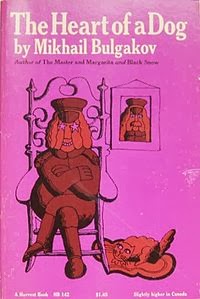
5/52: Heart of a Dog, by Mikhail Bulgakov
This author was recommended to me by a student. (At the beginning of every semester, I give a survey to my classes that asks them about their math backgrounds and their goals for the course, but also asks them for a movie/book recommendation for fun. I get a lot of interesting recommendations this way!) The library didn't have The Master & Margarita so I chose this instead. And I ended up reading it on two plane rides, to and from a conference. I don't believe I know enough about the historical aspects of the Russian revolutions to appreciate the allegorical aspects of the book, but I did enjoy the juxtaposition of deadpan realist narration with outlandish, gothic plot elements.
6/52: The Visible Man, by Chuck Klosterman
This was another quick read (two evenings). I'm already a Klosterman fan, but have mostly preferred his non-fiction work to, say, Downtown Owl (although I did like that one well enough). This one felt like a culmination of what Chuck is all about, what he's capable of, and what he goes for in his writing. I bet a lot of the characters and situations in this novel are based on people Chuck has known or, if not, things he has constructed in his head. This says several things about the man and his life: (i) he probably knows some fucked up people; (ii) he likely knows how to take fucked up stories and make them compelling and relatable; (iii) he might have a crazy imagination; and (iv) he possibly has an uncanny ability to make imaginative fiction into wholly believable storytelling. There are plentiful layers to the relationships and messages of this book, and I think part of the point is that we can forever debate them and never decide who is "right" and who is "lying" and who is "moral" and who is "crazy". This book is proof that you don't have to be overtly intellectual or dense or off-putting at all to be compelling, meaningful, and insightful.
This is where I am so far. Three weeks in, six books down. I like this pace, knowing that I can't keep it up; early in the semester, I hope to read as much as I feasibly can. Once March and April hit, I'll be in the mire of the spring semester. May and June will be better, and then I'm teaching again in July and August. So we'll see how this goes. I doubt I'll keep remotely close to a "one per week" average until the very end of the year.
Here's what I'm working on now:
A Clockwork Orange, by Anthony Burgess. Started this today, finally. Should be done this week. Compelling!
How to Travel with a Salmon, by Umberto Eco. A book I bought several months ago, read 10 pages of, and then abandoned. I'm starting it anew. A collection of humorous essays.
Gravity's Rainbow, by Thomas Pynchon. I haven't started this yet. But it's sitting by my recliner waiting. I don't often read very long fiction books, but when I do, I pick one and devote myself to it while keeping a couple of books going on the side. This is going to be my long fiction book for January/February. I'll start this weekend …
I've been reading a lot lately. By "a lot" I really mean "more than usual, on average over a given time frame, than in past years of my life". And by all of this I really mean that, over the last few months, I've found myself reading books (a) more often, (b) more voraciously, and (c) more sustainably than I usually do. I've enjoyed this trend quite a bit.
Last August, I started my first post-graduate school job. I'm now a mathematics instructor at a liberal arts college. This does not mean I find myself with more free time than in the past. (Despite what people say about graduate school, I think it's a great time to pursue hobbies and leisure activities; you just have to be more careful and adamant about managing your time.) If anything, quite the opposite. It's hard work fitting in to a new set of colleagues, working with an entirely new student body, managing expectations (both what you expect of your students and what they expect of you), and cultivating a social life, when you have time. But somehow, I've found myself with lots of time for pleasure reading.
Maybe it's just that I've finally decided, "I will make the time for pleasure reading. And I will do it often." I don't go to the movies. I don't go to bars on the weekends. I don't have cable. (I have a TV but haven't even bothered to put it up; even then, I'd likely only use it for DVDs and video games.) I don't follow sports. I don't mean to disparage these activities. Rather, I think these are activities that take up lots of time. Instead of doing those things, I find myself spending my time sitting in my recliner, putting an ambient record on the turntable (lately, it's been this one), and poring over a good book. And then another.
I've decided to track my progress through the literary landscape this year. More specifically, I've mentally committed myself to a "one book a week" journey. 52 weeks in a year. 52 books in a year. Sounds simple enough, no?
Thanks to the vacation time between the fall and spring semesters, I'm already well ahead of schedule. But I need this, because I presume the next few months will be all quiet on the reading front; once I have stacks of homework assignments to grade and class notes to prepare … I'll have ever-scanter time to devote to plowing through, say, The Brotherhood of the Grape. But the book will be there, beckoning me. So I'd like to use this as a public forum to not only make sure that I'm accountable to my commitment (like you give a shit, right?) but also to share my thoughts (like you give a shit, right?). Along with this, you can follow me on Goodreads.
With no more ados, here's what I've ingested so far:
1/52: Pym, by Mat Johnson
I started this when I was in NYC over New Year's and ended up finishing it on the bus ride back to Boston. I read it rather quickly, considering the length, and I'm sure this is due to the humor and pacing of the prose. It's meant to be fun, even though it's crazy. And racially-charged and, overall, demanding of your social attention. This was recommended to me by my mother because she was forced to read it for her job and she pretty much hated and found it weird and funky and, therefore, (quite correctly, mind you) presumed I would enjoy it. Keep 'em comin', mom.
2/52: The Fifth Child, by Doris Lessing
I took this out of my school's library after reading a headline that Lessing had passed away, back in November. I never knew of her during her life, but I figured now was as good a time as any to appreciate her writing. Not sure why I chose this particular novel; honestly, it was probably the slimmest novel in the library's collection. As it was, though, I sat down and finished this in one day. It's eerily gripping yet, even now weeks later, I'm not sure what to make of it. I think that's the point: so many circumstances tie us down and it's a daily/lifelong struggle to suss them out and prioritize. But it's never that simple either, even in retrospect.
3/52: Hyperbole and a Half: Unfortunate Situations, Flawed Coping Mechanisms, Mayhem, and Other Things That Happened, by Allie Brosh
Loved this. I mean, I already loved her blog and have been following for a while, but it was great to see things all together, in print, and read lots of new material. If you know this blog, then you've likely already read this book; if you don't know this blog, then you absolutely should. Here's why: 4/52: Zazie dans le Metro, by Raymond Queneau
I was tuned in to Queneau (and other Oulipo gangers) years ago by a friend. This particular book was purchased by me at a used book store years ago for the lowly sum of $5. This has to be one of my best used book finds of all time. This is an original 1959 Olympia Press printing, including delightful in-margin hand drawings by an illustrator and a lively dust jacket. (Consider this site, selling it for $48!) Forget the physicalities, though. This novel is delightful. Moreover, I marvel at the ingenious translation. The prose is as much about the use of Parisian and suburban/urban slang and wordplay as it is about a young girl and her uncle and their escapades in the city while the metro workers are on strike. I enjoyed this thoroughly, and aspire to know French well enough to read and appreciate this novel in its original version someday.
5/52: Heart of a Dog, by Mikhail Bulgakov
This author was recommended to me by a student. (At the beginning of every semester, I give a survey to my classes that asks them about their math backgrounds and their goals for the course, but also asks them for a movie/book recommendation for fun. I get a lot of interesting recommendations this way!) The library didn't have The Master & Margarita so I chose this instead. And I ended up reading it on two plane rides, to and from a conference. I don't believe I know enough about the historical aspects of the Russian revolutions to appreciate the allegorical aspects of the book, but I did enjoy the juxtaposition of deadpan realist narration with outlandish, gothic plot elements.
6/52: The Visible Man, by Chuck Klosterman
This was another quick read (two evenings). I'm already a Klosterman fan, but have mostly preferred his non-fiction work to, say, Downtown Owl (although I did like that one well enough). This one felt like a culmination of what Chuck is all about, what he's capable of, and what he goes for in his writing. I bet a lot of the characters and situations in this novel are based on people Chuck has known or, if not, things he has constructed in his head. This says several things about the man and his life: (i) he probably knows some fucked up people; (ii) he likely knows how to take fucked up stories and make them compelling and relatable; (iii) he might have a crazy imagination; and (iv) he possibly has an uncanny ability to make imaginative fiction into wholly believable storytelling. There are plentiful layers to the relationships and messages of this book, and I think part of the point is that we can forever debate them and never decide who is "right" and who is "lying" and who is "moral" and who is "crazy". This book is proof that you don't have to be overtly intellectual or dense or off-putting at all to be compelling, meaningful, and insightful.
This is where I am so far. Three weeks in, six books down. I like this pace, knowing that I can't keep it up; early in the semester, I hope to read as much as I feasibly can. Once March and April hit, I'll be in the mire of the spring semester. May and June will be better, and then I'm teaching again in July and August. So we'll see how this goes. I doubt I'll keep remotely close to a "one per week" average until the very end of the year.
Here's what I'm working on now:
A Clockwork Orange, by Anthony Burgess. Started this today, finally. Should be done this week. Compelling!
How to Travel with a Salmon, by Umberto Eco. A book I bought several months ago, read 10 pages of, and then abandoned. I'm starting it anew. A collection of humorous essays.
Gravity's Rainbow, by Thomas Pynchon. I haven't started this yet. But it's sitting by my recliner waiting. I don't often read very long fiction books, but when I do, I pick one and devote myself to it while keeping a couple of books going on the side. This is going to be my long fiction book for January/February. I'll start this weekend …
Labels:
52book,
a clockwork orange,
allie brosh,
book,
bulgakov,
burgess,
gravity's rainbow,
heart of a dog,
hyperbole and a half,
johnson,
klosterman,
lessing,
literature,
pym,
pynchon,
queneau,
visible man,
zazie
Saturday, June 30, 2012
Jam of the day and a lengthy review of POP!, a musical about Andy Warhol: Lou Reed & John Cale / "I Believe"
Artist: Lou Reed & John Cale
Album: Songs For Drella
Song: "I Believe"
Released: April 11, 1990
Label: Sire Records (Warner Music Group)
NOTE: I pretty much crapped out this lengthy diatribe a day or two after my viewing of POP! on May 10, 2012 (which I mention again later). I had a lot of thoughts about the play, and this Reed/Cale album that I relistened to a few times that day, sifting through the madness that is my brain (hah! I said my blog title!), and during the wee 2am-ish hours, I sat down and typed furiously without much self-censorship. I got up the next day and second-guessed myself about posting it. Then, I promptly forgot about the whole thing … until recently, when I decided to just say "Fuck it" and post the damn thing mostly unedited (save for some grammar cleanup and formatting). Keep that in mind as you read through. Ultimately, I decided that the thoughts I had were interesting enough and sharable, even if the verbose and, frankly, bombastic way in which I present them leaves much to be desired, and might even keep you from reading too much of it. In any event, that seems to be the opposite of the spirit of the blogger, so … in the immortal words of Kel, "Awww, here it goes!"
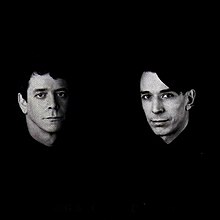
Songs For Drella is an album that I actually really enjoy but hardly ever want to listen to. (It's pretty much too intense, and I hope that the verbosity and indulgence of the ensuing paragraphs will convey this feeilng sufficiently well.) Think about that claim; I bet there are very few albums that can be described that way, for you and me. I bought a CD copy of this album years ago—I don't even remember where or exactly when, sometime late in college or shortly thereafter—when I was heavy into The Velvet Underground (not like that has changed, but back when it was still fresh), seeing that it was the first collaborative material from Lou Reed and John Cale since White Light/White Heat way back in 1968. For the uninitiated or those in need of refreshing, here's the super quick version: Reed & Cale were original members of The VU whose first album, 1967's The VU & Nico, was essentially produced and/or funded/curated somehow by Andy Warhol (at the very least, he paid for some recording and included them on his Exploding Plastic Inevitable extravaganza tour, with live music and dancing and light shows and movies and craziness); Cale quit the band in 1968 after two albums to pursue a solo career and produce/engineer albums, and eventually Reed did the same in 1970; the two were known to basically have mutual disgust for each other and didn't speak until Andy Warhol's funeral service in 1987; someone suggested they create some kind of memorial for Andy, and, a couple years later, Songs For Drella came out over the course of some small shows and an eventual recording and CD release.
The album itself is a rather artsy, lyrics-oriented concept album about Andy Warhol, in general, and Reed and Cale's relationships with and perceptions of Warhol, more specifically. They knew Warhol at the height of his New York City Factory days, acted in some of his movies, and were apparently rather friendly with him, in addition to their musical business relations. The songs on this album manage to explore Warhol's identity, his philosophies on art and life, and how he interacted with the many, many people who clung to his burgeoning, high-art-doesn't-mean-what-it-used-to-mean, societal lifestyle. The tunes are roughly chronological, too. Opener "Smalltown" describes Warhol's not-so-ideal childhood in the Steel City, his outcast role ("Bad skin, bad eyes, gay and fatty, people look at you funny"), and his real desire to "make it big" ("There's only one good thing about a small town, you know that you wanna get out"). The Reed-penned and -sung "Work" is apparently based on conversations Reed had with Warhol about producing his art and his view of it as … well, "work"; this might be due to him coming from Pittsburgh, how he supported his mother for most of his life, or just a serious work ethic, but it's interesting to think about these lyrics and his life's output and his mass-production style.
Andy said a lot of things, I stored them all away in my head
Sometimes when I can't decide what I should do I think, 'What would Andy have said?'
He'd probably say, 'You think too much, that's 'cause there's work that you don't want to do!'
'It's work, the most important thing is work!'
The next track, Cale's tune "Trouble With Classicists", is another take on Warhol's view of art. Verse by verse, it goes through and describes how Warhol would deconstruct another artist's particular style, as seen through the lens of looking at a tree. For instance, the "trouble with a classicist" is that "he looks at a tree and that's all he sees", and "he paints a tree". Building from just Cale's soothing voice into a rollicking piano line and Reed's snarly guitar riffs, this song is one of the highlights of the album. (For more thoughts on this album from a contemporary, i.e. 1990, standpoint, see this surprisingly stellar, nuanced, and empassioned Rolling Stone review, or this characteristically terse and unhelpful yet decidedly opinionated Robert Christgau review.)
At this point, though, I'll stop quasi-reviewing the album and outright quoting its lyrics. If you're someone who's remotely interested in The Velvet Underground and/or Lou Reed and/or John Cale, from a musical standpoint, or Warhol's art and the entire pop art scene as it developed over time, and the 1960s NYC scene associated with it, then I highly recommend you give this album a solid three or four listens. It's not going to really hit you hard on the first listen, I bet; if it does, awesome! If not, give it a little bit of time to sink in; read along with the lyrics; try to put yourself in Cale and Reed's shoes, making this material to honor their dead friend and benefactor despite hating each others' guts; and imagine how Warhol himself would view this album. Imagine him grinning quietly and nodding along, saying quite matter-of-factly, "Well, I thought it was wonderful when they said my name." (Somehow, that's what I imagine he would say.) If you like these musicians and/or this artist, you'll find a home in this album. Other standout tracks, in my mind, are "Images" (with Reed's insistent vocals about how Warhol comes up with art, I think, and a specific reference to Mao Tse Tung in a strangely compelling vocal inflection), "I Believe" (see below for more), "A Dream" (hazy guitar soundscapes from Reed and spoken word from Cale that's remarkably compelling), and "Hello It's Me", a final direct, honest message from Reed to Warhol and, if you're listening carefully, a real tear-jerker.
The particular tune I want to share from this album, though, is found towards the end of the album's track listing and corresponding chronology, and it is about a particularly troublesome event in Warhol's life and, I would imagine, the lives of everyone who knew him and cared about him. Despite this, I feel like it has escaped the modern art historical ethos and remains somewhat of a mystery to anyone who isn't particularly interested in Warhol's history, personally, or 20th century American art history, in general. Seriously, though; ask a bunch of your friends what they know about the attempted assassination of Andy Warhol. Odds are, close to (or a complete) majority will say, "What? Huh? That happened?!", while several more might say, "Oh yeah, he was shot or something, right?", while maybe a select few will say, "That Valerie Solanas sure was a bitch!". Maybe I'm wrong, but I doubt it. Somewhat luckily, though, there is a newish musical out on the theatre circuit that explores this exact event. POP!: Who Shot Andy Warhol? played at Pittsburgh's City Theatre on the South Side for a string of dates back in May, starring Broadway's Anthony Rapp (from Rent and Road Trip and other stuff) as Warhol. More info about that in a moment. Now, let's play that song I mentioned. It's all about Reed's apparent reaction to Solanas' shooting (I will make no association of Reed's vitriolic lyrics to Cale's mild-mannered persona) and the rough-around-the-edges guitar (especially that frantic solo from 2:05-2:18) combine rather well with the simple, staccato piano to convey that message.
Valerie Solanas took the elevator, got off at the 4th floor
She pointed the gun at Andy saying, 'You cannot control me anymore'
And I believe there's got to be some retribution
I believe an eye for an eye is elemental
Lou Reed & John Cale / "I Believe" / Songs For Drella [Sire, 1990]
Let's talk about that play now. I admittedly grew up being exposed to musical theatre fairly often, having a mother and sister who were huge fans, huge enough to "force" their tastes on me and subject me to live experiences, soundtrack CD listenings, cinema viewings, and so on and so forth. Mind you, I don't regret any of it, nor do I begrudge them; I'm just saying that, at the time, they probably weren't my favorite activities, but they were real, so now I associate them into my personality as they fit. Moving on. My sister acted and sang in a local (but decidedly professional and well-done, I might add) production of The Sound Of Music when I was in middle school (among other plays, musical or otherwise, throughout our lives), I saw Rent on Boston's "Broadway" in high school, I've seen numerous musical films (Grease, Bye Bye, Birdie, My Fair Lady, Mary Poppins, Hairspray, Chicago, etc.), and so on. My point: I'm not a typical male musical rube. So take my opinions with a grain of salt—according to my general thoughts about the genre and its temporaneous extinction—as well as a pinch of sugar—according to my life-long experience with and reluctant appreciation for the genre.
POP! is a big hit and a big miss, simultaneously. For me, as a now-and-again theatre-goer and general arts patron, I thoroughly enjoyed the "fresh" take on musicals, exploring the "underbelly" of the 1960s that hasn't really been touched by mainstream theatre since, say, Hair, I'd imagine. Also, though, as a serious fan of Warhol and The VU and the whole Factory scene as a conglomerate of interesting individuals with a lot to say about art and history and culture, I am somewhat disappointed. Anthony Rapp is a perfect fit for Warhol, and I take nothing away from his performance but reverence for the man; however, the mix of sarcastic, one-liner dialogue and indulgent, introspective, downright bombastic lyricism makes for a dischordant treatment of Warhol as a person and—from what I understand from every other treatment of him (e.g. his self-written books, his films and TV clips that I've seen at the Andy Warhol Museum over the years, Crispin Glover in his [albeit short] role as Warhol in The Doors movie—a not entirely accurate one.
Oddly, though, Andy Warhol doesn't seem to be the main focus of this production. The elaborate and overwrought—yet underveloped—treatment of the so-called "suspects" of the murder "mystery" comprise the majority of the plot. Edie Sedgwick. Viva. Valeria Solanas. That's it. The songs explore their personalities in one-dimensional ways—the blonde superstar who's a rich daddy's girl on the urban prowl, the intelligent black girl who's too smart to play games, the irreverent anti-male feminist who has a lot to say and a lot of energy with which to say it—that hardly ever touch on the subtleties that truly belong to them. Look, I even saw Factory Girl a couple years ago and thought it wasn't that great—or bad, mind you; it's really worth seeing if you've even read this far!—but it gives a decidedly more interesting, honest, and worthwhile treatment of Sedgwick's character in any 20 minute segment than POP! does throughout its run. But maybe that's not the point? Maybe this play isn't meant to explore all of the nuances of the Factory's multitude of colorful characters. Maybe POP! is about sensationalizing Warhol's life and, particularly, his violent shooting, and contorting that into a marketable production that might appeal to a wider public than would normally find fascinating a decades-dead artist who is (sadly) best known for copying soup can labels and scouring pad boxes.
I guess that is the point, and one that I had to come to terms with during my viewing of the show. (For reference's sake, I saw the 9:00 performance on Thursday, May 10; one day before official "opening night" at City Theatre here in Pittsburgh.) My eternal fandom for Warhol and the Factory scene makes me inherently question any inaccuracies and misrepresentations. On this note, I think the production completely obscures the original artistry and intrigue of the scene as it homogenizes it for a mainstream, modern audience; however, I am thankful for the play's existence and what it can possibly achieve for recognition and understanding of this particular branch of cultural and artistic history. Somewhat strangely, the most offensive character to me was not Warhol, but Gerard Malanga; luckily, he was not a particularly (ultimately) important persona (in the production, anyway!) so I retain hope for a na¨i;ve audience's take-away from the show.
I associate Gerard Malanga with the seedy side of The Velvet Underground, the fervent and ecstatic and outrageous live shows, the dancing, the whipping, the sexuality, the early punk attitude filtered through their urban hipsterism that preceded any kind of negative connotations of the term "hipster". I see him, in my mind's eye, as he appears in photographs in Uptight: The Velvet Underground Story, and as he has always appeared in my thoughts before owning that book. (The two imageries are notably similar, mind you.) In POP!, though, Malanga is a fucking cartoon, and there's no nice way to say this. Luckily, he is not an entirely crucial character in the overall story (he is important, but I can't imagine that a total "novice" to the narrative would find him irreplaceable) but he is decidedly influential, and it is bizarre to me to see him not in the typical tight leather denim pants and jacket, with a riding crop, but rather in a depressingly stereotypical paisley vest and bell bottoms, with a retro-fit and unoffensive haircut. It's weird and off-putting, really, but only to anyone who really cares. To the majority of the skewing-towards-elderly audience I saw at the performance I attended, nothing was out of the ordinary, and we could all sufficiently laugh at the delightful "speed freak homos" Malanga and Ondine as they tried to sort through the comical "pop bang mystery" as Andy Warhol "slept". Yeah. It's silly when you think about it, but that's exactly how the play works.
And yet ₀ here I am, compelled to return to my musical theatre "roots". And I can't help but avoid this conclusion: this is a remarkably watchable production. I would honestly recommend this to my friends and family to see. I bet you're surprised by that, if you've even fucking read this far, because—let's be honest—you've given up by now. (If you haven't, leave me a comment on this post with your favorite Velvet Underground song and I will buy you a beer sometime.) But that's how I feel. I had a great time at the show, barring my self-imposed discomfort with the treatment of Malanga, Warhol, and the overall scene, but I get the feeling that this is something I have to deal with on my own. And, ultimately, Brian Charles Rooney is SO FUCKING GOOD as Candy Darling. Literally, this is the best musical theatre role performance I've ever seen. She/he sings high and low, does drama and comedy, dances and walks around in heels, engages with the audience, and is an overall great representation of who I think the original character might be without trivializing the components of said character for the sake of the production. Kudos, Mr. Rooney. You are my new favorite actor. What's more, my date wasn't totally convinced of your male/female-ness (either way) until I mentioned it after the show and I showed her the program. So, double kudos!
The Velvet Underground / "Candy Says" / The Velvet Underground [MGM, 1969]
Meanwhile, I have no perception yet for how anyone else experienced this show, except for (a) my date, Lisa, who didn't know anything about the story going into this and was not a musical theatre conoisseur and yet enjoyed it enough to say she liked it and was glad we went; (b) this New York Times reviewer who laments Warhol's solo song, saying "Gee, Andy, I liked you so much better when you were making like an empty shell"; (c) this Post-Gazette reviewer who said, "How do you create a whodunit when the facts of the case are a Bing away?" (WTF?! BING?!); and (d) Lou Reed and John Cale, who have said all the things I've mentioned above (and more, of course) but only about Andy and his story and not this production.
Ultimately, I hope you do get out and see this show, in some capacity. I hope you listen to a song or two online, or go out and see it live. I hope you read a review online and share it with your friends. I hope you read Warhol's writings. I hope you listen to every Velvet Underground album (especially The VU & Nico) and Songs For Drella. I hope you form opinions about all of those artistic objects. I hope you package your ideas somehow. I hope you share them however you see fit: Blogger, Facebook, Twitter, Tumblr, the Post-Gazette comments section, YouTube, a musical response, a self-printed manifesto, a telephone chain campaign, a stint at Speakers' Corner, or just yelling in the mirror while you brush your teeth. Whatever it is, I hope you have an opinion and that it gets shared with the universe. Andy Warhol would be proud. He'd fucking love you. But he probably wouldn't say so. He'd likely smile at you, though. And maybe he'd put you in a movie.
Labels:
andy warhol,
candy darling,
city theatre,
edie sedgwick,
film,
gerard malanga,
jam,
jam of the day,
john cale,
lou reed,
musical,
Pittsburgh,
pop,
songs for drella,
Velvet Underground
Saturday, April 28, 2012
Jam of the day, vinyl you just have to buy, music inspired by history and literature, and a silly quote: The Byrds / "I Come And Stand At Every Door"
Artist: The Byrds
Album: Fifth Dimension
Song: "I Come And Stand At Every Door"
Released: July 18, 1966
Label: Columbia
I was really happy to score a near mint copy of this album at Jerry's Records this morning. The Byrds are one of my all-time favorite bands—if not the favorite—and this is one of their albums that I've never spotted at a store on vinyl. Sure, I could find a reissue online or whatever, but there's a certain thrill in having a few albums in the back of your mind all the time and knowing that you will, with absolute certainty, buy one whenever you see a copy for sale. Check this one off my list. I have a few others on mind. What albums are on YOUR list?
I also stopped in to Galaxie Electronics, which on the same floor as Jerry's on the right when you walk in, to buy a new belt for my turntable. I've had it about four years now and this is the first time I've had to fix anything, so I'm grateful for that. I've been putting that off for a couple of weeks, out of laziness and business, and between random shopping and Record Store Day last weekend, I've built up quite the backlog of albums I've been meaning to listen to. But screw all that, I had to but Fifth Dimension on as soon as I got home. I was planning on writing something about "Eight Miles High" (one of the most famous Byrds tunes and their first exploration into jazzy psych rock) or maybe the title track or maybe the silly little ditty "Mr. Spaceman", but then … I heard "I Come And Stand At Every Door".
I almost forgot this song was on this album. I almost forgot it even existed. It's kind of a throwaway, not really standing out as a stellar single or anything and, with its somber guitar line and rhythm and the deliberate vocal cadence, it's very much the least poppy track on an otherwise very upbeat and exciting record. Its the lyrical content, though, that really delivers the message. The words are an English translation of a poem by Turkish poet Nâzim Haket about the Hiroshima/Nagasaki bombings of WWII. It's written from the perspective of a seven year-old child (the poem says "girl" but the song's lyrics are slightly different and don't mention gender) who died in the bombings, and describes the child's death and how his/her spirit remains in this world and asks for nothing but peace. It's rather touching when you listen carefully and/or read along. Apparently Pete Seeger recorded a version of the poem in song form originally, in 1962, and The Byrds 1966 version added some somber electric guitars to the tune and really did it justice.
"I come and stand at every door
But no one hears my silent prayer
I knock and yet remain unseen
For I am dead, for I am dead"
Anyway, this song also got me thinking about other songs and albums that have been inspired (or are direct references to/usages of) historical events and/or literary pieces. We all know that Jeff Mangum says a fair amount of the content of In The Aeroplane Over The Sea was inspired by his recent reading of The Diary of Anne Frank. The only other really interesting example I can think of off the top of my head is If… which was apparently inspired by the Italo Calvino novel If on a winter's night a traveler. I haven't listened to that album, but I remember loving that novel when I read it in college. I still have a copy laying around here; I should pick it up again… Can you think of any other examples like this? I'll keep racking my brain and scouring the web. I'm sure there are some interesting ones!
One last thing: the remastered CD reissue of this album that came out on the album's 30th anniversary had a few bonus tracks: an alternate version of "Eight Miles High", two version of that single's B-side called "Why", a great David Crosby-penned tune called "Psychodrama City", and some others. The second version of "Why" is 17 minutes long, though, because after the tune ends and a radio promo interview with Roger McGuinn and David Crosby starts playing. It's kinda funny because you can only hear what those guys say, not the radio interviewer and not the songs they apparently play during the interview. But they say some pretty funny stuff as they talk about the album and the songs. It's worth tracking down and listening to if you're a big fan like me. I remember laughing so hard when they got to talking about the album name and the title track. Roger McGuinn says something silly like, "Well, the fifth dimension is a very philosophical place." Well said, dude.
Album: Fifth Dimension
Song: "I Come And Stand At Every Door"
Released: July 18, 1966
Label: Columbia
I was really happy to score a near mint copy of this album at Jerry's Records this morning. The Byrds are one of my all-time favorite bands—if not the favorite—and this is one of their albums that I've never spotted at a store on vinyl. Sure, I could find a reissue online or whatever, but there's a certain thrill in having a few albums in the back of your mind all the time and knowing that you will, with absolute certainty, buy one whenever you see a copy for sale. Check this one off my list. I have a few others on mind. What albums are on YOUR list?
I also stopped in to Galaxie Electronics, which on the same floor as Jerry's on the right when you walk in, to buy a new belt for my turntable. I've had it about four years now and this is the first time I've had to fix anything, so I'm grateful for that. I've been putting that off for a couple of weeks, out of laziness and business, and between random shopping and Record Store Day last weekend, I've built up quite the backlog of albums I've been meaning to listen to. But screw all that, I had to but Fifth Dimension on as soon as I got home. I was planning on writing something about "Eight Miles High" (one of the most famous Byrds tunes and their first exploration into jazzy psych rock) or maybe the title track or maybe the silly little ditty "Mr. Spaceman", but then … I heard "I Come And Stand At Every Door".
I almost forgot this song was on this album. I almost forgot it even existed. It's kind of a throwaway, not really standing out as a stellar single or anything and, with its somber guitar line and rhythm and the deliberate vocal cadence, it's very much the least poppy track on an otherwise very upbeat and exciting record. Its the lyrical content, though, that really delivers the message. The words are an English translation of a poem by Turkish poet Nâzim Haket about the Hiroshima/Nagasaki bombings of WWII. It's written from the perspective of a seven year-old child (the poem says "girl" but the song's lyrics are slightly different and don't mention gender) who died in the bombings, and describes the child's death and how his/her spirit remains in this world and asks for nothing but peace. It's rather touching when you listen carefully and/or read along. Apparently Pete Seeger recorded a version of the poem in song form originally, in 1962, and The Byrds 1966 version added some somber electric guitars to the tune and really did it justice.
But no one hears my silent prayer
I knock and yet remain unseen
For I am dead, for I am dead"
Anyway, this song also got me thinking about other songs and albums that have been inspired (or are direct references to/usages of) historical events and/or literary pieces. We all know that Jeff Mangum says a fair amount of the content of In The Aeroplane Over The Sea was inspired by his recent reading of The Diary of Anne Frank. The only other really interesting example I can think of off the top of my head is If… which was apparently inspired by the Italo Calvino novel If on a winter's night a traveler. I haven't listened to that album, but I remember loving that novel when I read it in college. I still have a copy laying around here; I should pick it up again… Can you think of any other examples like this? I'll keep racking my brain and scouring the web. I'm sure there are some interesting ones!
One last thing: the remastered CD reissue of this album that came out on the album's 30th anniversary had a few bonus tracks: an alternate version of "Eight Miles High", two version of that single's B-side called "Why", a great David Crosby-penned tune called "Psychodrama City", and some others. The second version of "Why" is 17 minutes long, though, because after the tune ends and a radio promo interview with Roger McGuinn and David Crosby starts playing. It's kinda funny because you can only hear what those guys say, not the radio interviewer and not the songs they apparently play during the interview. But they say some pretty funny stuff as they talk about the album and the songs. It's worth tracking down and listening to if you're a big fan like me. I remember laughing so hard when they got to talking about the album name and the title track. Roger McGuinn says something silly like, "Well, the fifth dimension is a very philosophical place." Well said, dude.
Labels:
1966,
columbia records,
eight miles high,
fifth dimension,
i come and stand at every door,
italo calvino,
jam,
jam of the day,
Jeff Mangum,
Jerry's,
nazim haket,
pete seeger,
poetry,
quote,
The Byrds,
vinyl
Friday, April 27, 2012
Jam of the day, psychedelia compilations, and vinyl conventions: D.R. Hooker / "Forge Your Own Chains"
Artist: D.R. Hooker
Album: The Truth
Song: "Forge Your Own Chains"
Released: 1972
Label: On Records [original] / Subliminal Sounds [reissue]
A friend of mine had a vinyl copy of Forge Your Own Chains: Psychedelic Ballads and Dirges 1968-1974 and played it on at least one occasion while we were hanging out at his place and in the right frame of mind for this album. Oh man, is it heavenly. A double LP compilation, with songs from Korean psychedelic guitarist Shin Joong Hyun, Nigerian rock band Ofege, a Temptations cover by a group of American soldiers who won a "Battle of the Bands" contest while stationed in Germany, and this here tune and namesake for the album by an underground Connecticut folk-rocker named D.R. Hooker. I've since gone on and bought a vinyl copy myself and highly recommend you do the same.
D.R. Hooker has a solid J.C. look about him, as you can see on the cover art for The Truth, his 1972 debut LP. He released another LP 7 years later, and another one in the late 1980s, but I've yet to track those down. I stumbled upon a reissue of this album on vinyl (via the Subliminal Sounds label) at the 7th (semi-)annual Pittsburgh Record Fest at Belvedere's a month ago. The event was pretty big, filling the huge back room of Belvedere's with tables and sellers and people milling about. I got there with some friends on the later end of the evening, and probably missed out on some great scores because of that, but it felt like I didn't see a whole lot of stuff that "grabbed" me. This record was the only one I picked up that made me say, "I have to have this." I made some other finds, but this was my favorite by far.
Here's the jam that got this whole story started. It's a catchy little ditty in the middle of the LP, piecing together a tambourine beat and stuttery drums with D.R. Hooker's smooth voice and a cool bass line, plus some awesome jazzy punches of brass. It's really, really … cool. Suave.
D.R. Hooker / "Forge Your Own Chains"
"One more cigarette to clear your head
Today you're living, tomorrow you're dead"
Some other links about D.R. Hooker I found: Buried Treasure / 99 Krap Rec / The Truth
I'm always on the lookout for other sweet compilation albums, after experiencing the greatness of this one. This also led me to buy an album of Shin Joon Hyung tunes called Beautiful Rivers & Mountains and it is similarly outstanding and highly recommended. Do you know of any other compilations like this that you'd recommend? LET ME KNOW!
Shin Jung Hyun (ft. Jang Hyun) / "Twilight"
Album: The Truth
Song: "Forge Your Own Chains"
Released: 1972
Label: On Records [original] / Subliminal Sounds [reissue]
A friend of mine had a vinyl copy of Forge Your Own Chains: Psychedelic Ballads and Dirges 1968-1974 and played it on at least one occasion while we were hanging out at his place and in the right frame of mind for this album. Oh man, is it heavenly. A double LP compilation, with songs from Korean psychedelic guitarist Shin Joong Hyun, Nigerian rock band Ofege, a Temptations cover by a group of American soldiers who won a "Battle of the Bands" contest while stationed in Germany, and this here tune and namesake for the album by an underground Connecticut folk-rocker named D.R. Hooker. I've since gone on and bought a vinyl copy myself and highly recommend you do the same.
D.R. Hooker has a solid J.C. look about him, as you can see on the cover art for The Truth, his 1972 debut LP. He released another LP 7 years later, and another one in the late 1980s, but I've yet to track those down. I stumbled upon a reissue of this album on vinyl (via the Subliminal Sounds label) at the 7th (semi-)annual Pittsburgh Record Fest at Belvedere's a month ago. The event was pretty big, filling the huge back room of Belvedere's with tables and sellers and people milling about. I got there with some friends on the later end of the evening, and probably missed out on some great scores because of that, but it felt like I didn't see a whole lot of stuff that "grabbed" me. This record was the only one I picked up that made me say, "I have to have this." I made some other finds, but this was my favorite by far.
Here's the jam that got this whole story started. It's a catchy little ditty in the middle of the LP, piecing together a tambourine beat and stuttery drums with D.R. Hooker's smooth voice and a cool bass line, plus some awesome jazzy punches of brass. It's really, really … cool. Suave.
D.R. Hooker / "Forge Your Own Chains"
Today you're living, tomorrow you're dead"
Some other links about D.R. Hooker I found: Buried Treasure / 99 Krap Rec / The Truth
I'm always on the lookout for other sweet compilation albums, after experiencing the greatness of this one. This also led me to buy an album of Shin Joon Hyung tunes called Beautiful Rivers & Mountains and it is similarly outstanding and highly recommended. Do you know of any other compilations like this that you'd recommend? LET ME KNOW!
Shin Jung Hyun (ft. Jang Hyun) / "Twilight"
Labels:
1972,
compilation,
connecticut,
d.r. hooker,
forge your own chains,
jam,
jam of the day,
mp3,
Pittsburgh,
psychedelia,
shin joong hyun,
video,
vinyl,
vinyl convention
Sunday, April 1, 2012
Jams of the day, band name stories, and the many projects of J Mascis: Heavy Blanket / "Dr Marten's Blues" & Electronic Anthology Project / "Tarpit"
I've heard about two musical projects in the last couple of months and just about the only thing they have in common is one man: J Mascis. This guitar wizard has played in so many great bands and released so much awesome music into the world, and there's clearly no end in sight. Dinosaur Jr. is amazing, of course, and I was really wowed by last year's solo LP, Several Shades of Why. Great songwriting, and that growly voice of his still holds up in an acoustic setting like that.
I saw on Pitchfork last week that J and some pals will release an LP of instrumental psychedelic rock tunes in May. They've shared one track, "Dr Marten's Blues", and it is an absolute scorcher. Well, it's actually just a catchy bass rumble and a pounding beat that almost serves as an excuse for J to shread a massive guitar solo over the whole thing for four minutes. Yeah. I mean, it's an awesome solo. I literally can't stop listening to it. I'm pretty sure the whole LP will be like this, which … actually intrigues me.
Another part of this story, besides the surprising and weird nature of it all, is that the band apparently has a crazy, wild, pretty much unbelievable story. I'm sure it's rooted in some truth, but … it's hard to say. You can read the whole thing on their record label's website and see for yourself, but here's a choice selection:
I imagine that the Heavy Blanket moniker has something to do with the thick, sumptuous slab of sound these guys produce, or something about what this type of music does to your brain … you get the idea. But it makes me think about how bands get together, decide on a name, name some tracks and an album. There's a lot of naming. My favorite band name story is far-and-away Yo La Tengo, though; here's a great video of Ira Kaplan (and special guest!) describing the story.
The other musical venture I heard about recently is one by Built To Spill's bassist, Brett Nelson. His Electronic Anthology Project … er, project … covers entire albums of rock music in a more electronic/synthified way. His description sums it up nicely:
I saw on Pitchfork last week that J and some pals will release an LP of instrumental psychedelic rock tunes in May. They've shared one track, "Dr Marten's Blues", and it is an absolute scorcher. Well, it's actually just a catchy bass rumble and a pounding beat that almost serves as an excuse for J to shread a massive guitar solo over the whole thing for four minutes. Yeah. I mean, it's an awesome solo. I literally can't stop listening to it. I'm pretty sure the whole LP will be like this, which … actually intrigues me.
Another part of this story, besides the surprising and weird nature of it all, is that the band apparently has a crazy, wild, pretty much unbelievable story. I'm sure it's rooted in some truth, but … it's hard to say. You can read the whole thing on their record label's website and see for yourself, but here's a choice selection:
He remembered a couple kids from his early high school days – stoner kids he’d always admired for their “who gives a shit” attitude. Those kids, Johnny Pancake and Pete Cougar, had been kicked out of marching band for smoking weed out of a tuba. Way better musicians than the marching band deserved, they’d formed a duo that was all rhythm section – no vocals, no guitar, a sick, punchy brew of Band of Gypsies and Japanese hard psych (Johnny’s uncle was a US Marine stationed on Okinawa in 1973. From his frequent visits to Tokyo, he brought home a killer psych record collection. And a mean dose of the clap). These were the guys he needed. He rounded them up and it soon became obvious that the heavy rhythms they created were the perfect backdrop to young Mascis’ insane, fluid ability on the guitar. The trio came up with six blistering tracks, named themselves Heavy Blanket, and set a date to record.
I imagine that the Heavy Blanket moniker has something to do with the thick, sumptuous slab of sound these guys produce, or something about what this type of music does to your brain … you get the idea. But it makes me think about how bands get together, decide on a name, name some tracks and an album. There's a lot of naming. My favorite band name story is far-and-away Yo La Tengo, though; here's a great video of Ira Kaplan (and special guest!) describing the story.
The other musical venture I heard about recently is one by Built To Spill's bassist, Brett Nelson. His Electronic Anthology Project … er, project … covers entire albums of rock music in a more electronic/synthified way. His description sums it up nicely:
I truly love bands like Talk Talk, Men Without Hats, and Orchestral Manoeuvres In The Dark, but I also love bands like Dinosaur Jr., The Replacements, and The Pixies. So what if I merged my two loves together?An upcoming LP—set for release on Record Store Day—will have nine Dinosar Jr. tracks, with J Mascis singing on each one. (He might have re-recorded these vocals for this release? Not totally sure.) Have a listen to the old and the new versions here and see what you think. I'm intrigued but probably not enough to actually buy anything …
Labels:
band names,
crazy,
dinosaur jr,
electronic anthology project,
heavy blanket,
j mascis,
mp3,
new wave,
news,
pitchfork,
record store day,
soundcloud,
stream,
synth pop
Subscribe to:
Posts (Atom)